
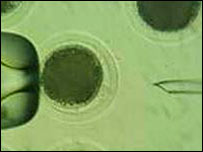
Cloned animals are 'safe to eat'

Praxius

Mass'Debater
Dec 18, 2007
10,677
161
63
Halifax, NS & Melbourne, VIC


http://news.bbc.co.uk/2/hi/science/nature/7190305.stm

Meat and milk from cloned animals is generally safe to eat, the US Food and Drug Administration (FDA) has declared.

Following six years of study, it ruled that food from cloned pigs, cattle and goats and their offspring is as safe as food from conventionally-bred animals.

Lack of data meant the agency could not reach a decision on sheep products.

The FDA does not expect to see a lot of products from cloned animals being sold, because of cost. It says clones would be used mainly for breeding.

The agency released almost identical draft conclusions in December 2006. Since then, new scientific information has strengthened its central view.

"After reviewing additional data and the public comments in the intervening year since the release of our draft documents on cloning, we conclude that meat and milk from cattle, swine, and goat clones are as safe as the food we eat every day," said Stephen Sundlof, director of the FDA's Center for Food Safety and Applied Nutrition.

The finding also confirms the conclusions of an investigation released in 2002 by the US National Academy of Sciences.

The FDA will not require food derived from cloned animals to be labelled as such.

Low confidence

The agency was criticised by activist groups and by US politicians who were not convinced that enough scientific data was available to justify a decision.

"The FDA has acted recklessly, and I am profoundly disappointed in their rush to approve cloned foods," said Maryland Senator Barbara Mikulski, co-sponsor of a bill amendment passed by the US Senate which asked the FDA not to rule until further research was available.

"Just because something was created in a lab, doesn't mean we should have to eat it." Her criticisms were echoed by Andrew Kimbrell of the Center for Food Safety, a prominent US pressure group.

"The FDA's bull-headed action disregards the will of the public and the Senate and opens a literal Pandora's Box," he said.

"The FDA based their decision on an incomplete and flawed review that relies on studies supplied by cloning companies that want to force cloning technology on American consumers."

A survey in 2005 by the Pew Charitable Trusts found that two-thirds of US consumers were "uncomfortable" with animal cloning; nearly half believed food from clones would be unsafe to eat.

Some US food companies have indicated they do not plan to stock products derived from cloned animals.

But Smithfields, which claims to be the biggest producer of pigs and pork products in the country, left the door open to a change of tack, saying it would "continue to monitor further scientific research on this technology" and was committed to improving its products "through careful selective breeding and genetic research".

Breeders themselves expressed their approval.

"The biotechnology industry applauds the FDA for its comprehensive scientific review of this new assisted reproductive technology," said Jim Greenwood, president and CEO of the Biotechnology Industry Organization (Bio), which represents companies and institutions in the biotech field.

"Cloning... can effectively help livestock producers deliver what consumers want: high-quality, safe, abundant and nutritious foods in a consistent manner."

Delayed action

US authorities do not expect to see a wave of products derived from cloned animals on the shelves immediately.

Creating a clone is far more expensive than breeding animals conventionally. The US Department of Agriculture (USDA) believes it is more likely that companies will produce clones with "desirable" traits, breed them, and bring products from the offspring into the food chain.

The USDA is asking companies not to market products immediately, but to continue observing the moratorium they agreed to in 2001 when the FDA began its deliberations.
"USDA encourages the cloning industry continue its voluntary moratorium for a sufficient period of time to prepare so that a smooth and seamless transition into the marketplace can occur," it said in a statement.

The US developments will be watched closely in Europe, where evaulation of cloned animals is at an earlier stage.

Last week the European Food Safety Authority (Efsa) initiated a public consultation on its draft guidance.

The draft concluded, among other things, that:
  • foods from cloned pigs and cattle are essentially identical to those from conventionally bred animals
  • animal cloning is unlikely to have environmental impacts
  • there are health and welfare issues, but these are likely to diminish as technology progresses
The EU has indicated that if products from cloned animals were approved, they would have to be labelled.
This contrasts directly with the US position, opening up the possibility of trade disputes similar to the lengthy and costly row between the EU and US over genetically modified foods.

Ok, great, the US agencies claim cloned food is safe to eat, but do not plan on labeling them as cloned products and just expect to throw cloned food in with the normal food.

They may think the cloned food is just as safe as real food, but the process is in the hands of man, not nature. All is required is for someone to screw up a gene and then it's sent off to all of us to eat which may have an adverse reaction to people who eat it... be that a new virus, an alergic reaction, or just basically makes the steak taste like chocolate.

But if something deadly serious occured from these cloned products and thousands of people eat the tainted product, there is of course no way of tracing back where it came from.... BECAUSE they're not labeled differently from normal food products.

Smooth Move Ex-Lax!

That and from the above:

"The FDA based their decision on an incomplete and flawed review that relies on studies supplied by cloning companies that want to force cloning technology on American consumers."

Even if the comment wasn't accurate either, it does raise some concerns about how they came to their conclusions.

It's the same thing with Tasers.... the final conclusions on their safety were determined by the same kind of reports from the company which designed the Taser, and not from any actual reports from the police departments which use them.

Cloned food, means another grubby human's hands are in the development process to the very genetics. One tweak here or there could make meat tastier, then again.... it would also kill or cause more forms of cancer.

Frig Cancer is in everything these days for some reason or another.... start screwing around with genetics to improve the food we eat... guess what happens?

I'm at least glad it's the US starting this off and not my country.... let them be the lab rats to prove they're safe. I'm also glad that the EU is planning to label their products. It at least helps to track things down better if and when something serious occurs.
 

jenn

Electoral Member
Jan 13, 2008
626
14
18
ya pass the potatoes and veggies..I will skip the meat... but sometimes I wonder if it is really much different than...
"Actually, cloning isn’t new at all. In fact, we eat clones all the time, in the form of bananas and grafted fruits. We’ve been cloning plants for decades, except that we refer to it as “vegetative propagation.” It takes about 30 years to breed a banana from seed, so, to speed the process of getting fruit to market, most bananas, potatoes, apples, grapes, pears, and peaches are clones."
 

karrie

OogedyBoogedy
Jan 6, 2007
27,780
285
83
bliss
cloning and genetic modification aren't necessarily the same thing.

But I agree with you, if it's going to market it had better be marked.

What I don't get is why it's an issue. It makes no sense to farm cloned animals. It's more costly than conventional husbandry, and it opens your stock up to the risk, being all identical, of being completely wiped out by one flaw, such as no resistance to one particular virus, or a susceptibility to a particular vitamin deficiency. At least a varied, conventional stock increases the odds that you will have some standing if an epidemic of some sort hits.
 

Tonington

Hall of Fame Member
Oct 27, 2006
15,441
150
63
Yah, I don't really see the point of cloning animals for human consumption either. Not on the ethics, but the economics. I could see possibly cloning of sires that produced excellent offspring, but not cloning a whole herd/flock of animals.


Like if you want to get rid of some trait in the population, sometimes it takes up to 40 generations before the gene is gone. Could be done much more quickly with cloned animals.
 

Praxius

Mass'Debater
Dec 18, 2007
10,677
161
63
Halifax, NS & Melbourne, VIC
cloning and genetic modification aren't necessarily the same thing.

But I agree with you, if it's going to market it had better be marked.

What I don't get is why it's an issue. It makes no sense to farm cloned animals. It's more costly than conventional husbandry, and it opens your stock up to the risk, being all identical, of being completely wiped out by one flaw, such as no resistance to one particular virus, or a susceptibility to a particular vitamin deficiency. At least a varied, conventional stock increases the odds that you will have some standing if an epidemic of some sort hits.

Well see that's also another point. So we clone our meat and milk and such, but after so many years of eating the exact same thing, the same nutrients in them, the exact same level of vitamins, the exact same animal over and over again..... wouldn't that cause problems within our own bodies?

I mean sure, most cattle and other farmed animals are all feed the same amount and milked the same amount, and bred the same amount, but each one is genetically different, with different traits, different heights, strengths, weaknesses, Differences. In much of our food, it's all different to some degree.

And to tangent that, animals, and other living creatures (most anyways) breed with another of the same species in order to change their genetic code, to prevent mass extinction from some cause, as you mentioned above Karrie. But what if we're still not looking at the entire core of DNA and how it works, like science always ends up doing.

I'm not saying science doesn't know what it's talking about, I'm saying they sometimes don't fully know what they are talking about until they have more time to pass for more study. Much like Hydronated Oils.... seemed like a good idea at the time.

But we eat food, not just to keep us alive and for our organs to function, but our DNA and health of it is based on our consumption of just about everything. High doses of Calcium saturate DNA and actually prevent decay over time from oxidants, thereby slowing the age effect on our bodies.

But what happens when our food and drink taken into our bodies is the exact same all the time? What happens to our DNA not getting a variety? Sounds almost like a different plane of inbreeding.

Then again maybe I've just wasted your own life by reading this, because I don't know what I'm talking about.

We shall never know..... Doom doom da da'doom.... Oooo I'm scared.

But seriously... there are a lot of unknowns, and I'll be damned if I'm gonna trust the continual mentality in the US of trusting the studies of those shoving their products in your face. Actually come to think about it, they do that in all sorts of levels.

Another problem I just thought about, is if the US is not going to label which of their products are clones, then what sort of regulations will Canada and other countries have in place to make sure we know what is coming accross the border? Or should we just ban their products suspected of being clones?

Think about it. We're already paranoid about China's products due to recent events. Now that there's attention about this attempting to make change, here comes the US trying to give us clones.

To what end? Why? What's wrong with the way we get our food now?

Climate Change / Global Warming making it difficult to afford to keep farms going or something? I doubt it.

I just don't see the point in cloning our food of all things. More problems then solutions are going to come from this.
 

jimshort19

Electoral Member
Nov 24, 2007
476
11
18
27
Zurich
Praxius, "They may think the cloned food is just as safe as real food, but the process is in the hands of man, not nature. All is required is for someone to screw up a gene and then it's sent off to all of us to eat which may have an adverse reaction to people who eat it... be that a new virus, an alergic reaction, or just basically makes the steak taste like chocolate."

Praxius, you have a vivid imagination. A new virus? We've been eating GM food for years. Canola oil is a huge success, invented in Saskatchewan. Your fear of the unknown has overcome you, while you mix a thousand inadequately tested chemicals yourself, in your own home. Your risk assessment is not rational.

If a food is not cloned or genetically modified, irradiated or fortified with chemicals, it's not new and improved. Now that they can mix genes between all manner of plants and animals, while the dream of teleportation remains confined to thje night, the mixture of insect and mammal as depicted in the movie 'The Fly' is as close as your grocery isle.

I am against discriminatory food labelling. If some genetic material happens to be radiation-mutated material grafted from a fruit fly, it's really just intelligent design after all.
 

Outta here

Senate Member
Jul 8, 2005
6,778
158
63
Edmonton AB
Meat and milk from cloned animals is generally safe to eat, the US Food and Drug Administration (FDA) has declared.
Super. I generally like to have a more definitive assurance that my food is safe to eat than a rather vague 'generally'.

The FDA will not require food derived from cloned animals to be labelled as such.
Why not?? I know you already commented on that Praxious, but I have to add my incredulity to yours.

foods from cloned pigs and cattle are essentially identical to those from conventionally bred animals
animal cloning is unlikely to have environmental impacts
there are health and welfare issues, but these are likely to diminish as technology progresses
Great. More generalizations. I want better research before I see this on our store shelves. This has forced me to go see what I can find on Canada's stance on this issue.

.... and having just googled the question, I can find nothing more recent than 2006???

I've got to be looking in the wrong places... can anyone link me up to something relevant to Canada's stance?
 

Praxius

Mass'Debater
Dec 18, 2007
10,677
161
63
Halifax, NS & Melbourne, VIC
Praxius, you have a vivid imagination.

I've been told that once or twice in my day. Maybe it had to do with that entire economy sized bottle of Flintstone chewables that I ate when I was 5. They gave me crap to puke it up in the hospital, but nothing happened.

Since then I have spidy senses and super Fred abilities, like driving a car with my own feet, and Bam Bam's ability to smash things good with a big tree branch. You don't wanna know my Welma super ability. You can learn about that on the internet.... er... somewhere else.

A new virus? We've been eating GM food for years. Canola oil is a huge success, invented in Saskatchewan. Your fear of the unknown has overcome you, while you mix a thousand inadequately tested chemicals yourself, in your own home. Your risk assessment is not rational.

If a food is not cloned or genetically modified, irradiated or fortified with chemicals, it's not new and improved. Now that they can mix genes between all manner of plants and animals, while the dream of teleportation remains confined to thje night, the mixture of insect and mammal as depicted in the movie 'The Fly' is as close as your grocery isle.

I am against discriminatory food labelling. If some genetic material happens to be radiation-mutated material grafted from a fruit fly, it's really just intelligent design after all.

Well first I'm not fearful of the unknow... as my french squad leader used to say "You tink I know Fok No'ting? I know Fok All!" *Points finger and shakes up in the air*

I'm not afraid of much, I just choose not to eat something that was made in some United States Science lab. I'd rather eat cooked dog meat couriered over from china in a cargo ship then to eat US Cloned Pig Ass.... that's right. I'm talking about Bacon! I prefer to call it "being picky."

Tell you what... You try it first and tell me how much you enjoy it, or shrug and go "Meh... I had better" ~ Either way, I'll stick to real meat that was born inside another chunk of real meat, which got it on with some bigger real meat... with horns.

Don't make me go out and hunt it myself! :p
 

Tonington

Hall of Fame Member
Oct 27, 2006
15,441
150
63
Here's a little more perspective on the clone issue.
Cloned meat safe to eat, FDA says


LAURAN NEERGAARD
The Associated Press
January 15, 2008 at 1:06 PM EST

WASHINGTON — Meat and milk from cloned animals is as safe as that from livestock bred the old-fashioned way, the U.S. Food and Drug Administration said Tuesday.

The decision removes the last U.S. regulatory hurdle to marketing products from cloned cows, pigs and goats, and it puts the FDA in concert with recent safety assessments from European food regulators and several other nations.

“The data show that healthy adult clones are virtually indistinguishable” from their counterparts, concludes the FDA's safety report.

For economic reasons, however, it will be years before many foods from cloned animals reach store shelves. At $10,000 to $20,000 per animal, they are a lot more expensive than ordinary cows. That means producers likely will use clones' offspring for meat rather than the clones themselves.


Cloned food safe, FDA says
The FDA says meat and milk from cloned animals is as safe as that from their counterparts bred the old-fashioned way


In addition, several large food companies – including dairy giant Dean Foods Co. and Hormel Foods Corp. – have said they have no plans to sell milk or meat from cloned animals, because of consumer anxiety about the technology.

With FDA's ruling, “If you ask what's for dinner, it means just about anything you can cook up in a laboratory,” said Carol Tucker-Foreman of the Consumer Federation of America, who pledged to push for more food producers to shun cloned animals.

The two main U.S. cloning companies, Viagen Inc. and Trans Ova Genetics, have already produced more than 600 cloned animals for U.S. breeders, including copies of prize-winning cows and rodeo bulls.

“We certainly are pleased,” Trans Ova president David Faber said, noting that previous reports by the National Academy of Sciences and others have reached the same conclusion.
“Our farmer and rancher clients are pleased because it provided them with another reproductive tool,” he added.

Food producers have voluntarily withheld cloned animals from the market pending FDA's decision, and it was not immediately clear Tuesday if that moratorium was ending immediately – or if other government agencies must weigh in first.

The ruling was long-expected – and mirrors FDA's initial safety assessment back in 2003 but is but highly controversial nonetheless. Debate has been fierce within the Bush administration as to whether the FDA should move forward, largely because of trade concerns. Consumer advocates petitioned against the move, and Congress had passed legislation urging the FDA to study the economic ramifications before moving ahead.

It was a day forecast since 1997, when Scottish scientists announced they had successfully cloned Dolly the sheep. Ironically, sheep aren't on the list of FDA's approved cloned animals; the agency said there wasn't as much data about their safety as about cows, pigs and goats.
By its very definition, a successfully cloned animal should be no different from the original animal whose DNA was used to create it.

But the technology has not been perfected – and many attempts at livestock cloning still end in fatal birth defects or with deformed fetuses dying in the womb. Moreover, Dolly was euthanized in 2003, well short of her normal lifespan, because of a lung disease that raised questions about how cloned animals will age.

The FDA's report acknowledges that, “Currently, it is not possible to draw any conclusions regarding the longevity of livestock clones or possible long-term health consequences” for the animal.

But the agency concluded that cloned animals that are born healthy are no different from their non-cloned counterparts, and go on to reproduce normally as well.

“The FDA says, 'We assume all the unhealthy animals will be taken out of the food supply,”' said Joseph Mendelson of the Center for Food Safety, a consumer advocacy group that opposes the FDA's ruling. “They're only looking at the small slice of cloned animals that appear to be healthy. ... It needs a lot further study.”
 

Praxius

Mass'Debater
Dec 18, 2007
10,677
161
63
Halifax, NS & Melbourne, VIC
clone offspring is still a clone. In fact, if you mate two clones, you don't have inbreeding, it's mastubation. How does it sound to eat something that was made through masturbation?

Doesn't sound pretty does it?

Either way, I don't want to eat cloned pig arse as mentioned before, and I'd much like to choose from the two.

Mmmm.... What's for dinner is whatever you can make in the lab. I'll just wait a few years to see how that works.
 

Tonington

Hall of Fame Member
Oct 27, 2006
15,441
150
63
clone offspring is still a clone. In fact, if you mate two clones, you don't have inbreeding, it's mastubation. How does it sound to eat something that was made through masturbation?

Umm, no it isn't. You clone a cow, and the offspring it produces will not be the same as the offspring the original produced. There are literally billions of combinations that the single zygote can be drawn from. The probabilities of certain genes being passed on are the same, but the actual genetic make-up that is passed on is not the same at all. Inbreeding is not uncommon in animal agriculture. How do you think they produce new breeds? Inbreeding produces more homozygotes, outbreeding produces more heterozygotes.

The value of any individual as far as it's genetics are concerned is called it's breeding value. Of course that depends on which genes you find favourable.

Mmmm.... What's for dinner is whatever you can make in the lab. I'll just wait a few years to see how that works.

No, in this case what's for dinner is the offspring of something made in the lab. Big difference. And if you read the article, you'll notice the two largest companies have only produced a little over 600 cattle this way. That's 0.000035% of the US cattle herd. In fact it's statistically irrelevant. Random mutations are more common than that.
 

karrie

OogedyBoogedy
Jan 6, 2007
27,780
285
83
bliss
clone offspring is still a clone. In fact, if you mate two clones, you don't have inbreeding, it's mastubation. How does it sound to eat something that was made through masturbation?

Cloning them doesn't change their gender. Cloned sheep A and cloned sheep B mating isn't anywhere remotely near to anything you could equate with masturbation, since they are different both in gender AND genetics.
 

Praxius

Mass'Debater
Dec 18, 2007
10,677
161
63
Halifax, NS & Melbourne, VIC
I'll still wait. Case in point have been the last number of decades where these same organizations claim something new is great, healthy and better for you then the old thing we all used to use. Then in about 10-15 years we start noticing things like increased cancers, more heart complications, greater obesity.

Then we're told Oh No! we found out this thing we said was so great is related to all these problems. Then it costs billions over years to make all the companies switch back over to something else, and all the while all these people who are now burdened by these health problems, get nothing except to die.

Clone or not, I have seen a pattern over the years on plenty of products and for me, it is only logical to be cautious and see how it works before I start shoving it down my mouth.

It's not being scared of what I don't know, it's not being stupid about something they don't know yet.
 

Praxius

Mass'Debater
Dec 18, 2007
10,677
161
63
Halifax, NS & Melbourne, VIC
Cloning them doesn't change their gender. Cloned sheep A and cloned sheep B mating isn't anywhere remotely near to anything you could equate with masturbation, since they are different both in gender AND genetics.

Well I imagine through time, they'll just start modifying the genetics to make them what they want, including gender. In the long run after doing this so long, what do they have planned? Will they continue to sample new DNA to keep things fresh, or will they just rely on what they have stored from the breeding of the same cattle over the years because it's cheaper?

I'm pretty sure that once this cloning becomes main stream, there will be modification shortly afterwards. Perhaps I didn't clarify my connection to genetic modification earlier.

Either way, if I understand it or not, I still don't see any need to do this when the old system still works and is more cost effective. The fact that there are 600 cattle already out there doesn't sound all that great.

The flags in the original post brought up by the listed organizations above raised some flags to me and seemed ligit to show a bit of concern.
 

karrie

OogedyBoogedy
Jan 6, 2007
27,780
285
83
bliss
Well I imagine through time, they'll just start modifying the genetics to make them what they want, including gender. In the long run after doing this so long, what do they have planned? Will they continue to sample new DNA to keep things fresh, or will they just rely on what they have stored from the breeding of the same cattle over the years because it's cheaper?

I'm pretty sure that once this cloning becomes main stream, there will be modification shortly afterwards. Perhaps I didn't clarify my connection to genetic modification earlier.

Well, while I think it ought to be labeled and clearly a consumer choice, I do see where cloned animals would be of high value to the cattle industry. While selling strands or mating works fine right now, being able to guarantee that you're getting a good specimen, rather than some fluke of breeding which could be sickly and underweight, can be very valuable. It would mean that it would be possible to keep bigger, better breeding stock on hand at all times.

As for modification, well, I've seen enough 'natural modification', selective breeding, in my day to know that our food supply isn't exactly free of human tampering. :smile: