


Anyone seeing the signs?
- Thread starter 55Mercury
- Start date
You are using an out of date browser. It may not display this or other websites correctly.
You should upgrade or use an alternative browser.
You should upgrade or use an alternative browser.


I went on a flyer wondering if lunar cycles had anything to do with bird migrations in pulses.
Here is what I learned...
Yes — for certain birds, especially nocturnal insectivores, migration intensity often occurs in synchronized pulses timed to the lunar cycle.
The clearest and best-documented example is the European nightjar (Caprimulgus europaeus). A 2019 study in PLOS Biology (Norevik et al.) used GPS loggers, geolocators, and multi-sensor tags on dozens of individuals tracked between northern Europe and sub-Saharan Africa.
Key findings:
Nightjars more than doubled their nocturnal foraging activity on bright, moonlit nights. As visual hunters of flying insects, they gain a clear feeding advantage under moonlight.
This creates a fueling cycle: birds build reserves most efficiently around the full moon.
Migratory flight nights then peak roughly 11 days after full moon, when foraging opportunities decline.(see below) In some periods, nearly 100% of the tracked birds departed in the same narrow window — producing clear, population-level pulses of migration rather than a steady trickle.
journals.plos
The authors concluded that the lunar cycle can act as a large-scale temporal regulator that synchronizes the progression of individuals and creates pulses across the migratory population, with potential knock-on effects for ecosystems.
Broader patterns in birds
Related nightjar-family species (e.g., Eastern whip-poor-wills) also show strong avoidance of departing on full-moon nights and adjust timing relative to lunar phase.
Some seabirds increase nocturnal flight or adjust activity with moonlight (e.g., Cory’s shearwaters fly more on moonlit nights during migration; Barau’s petrels show lunar influence on colony returns).
A more recent study on Eurasian skylarks found higher occurrence and abundance of nocturnal migrants on nights with greater moon fraction and moonlight intensity — contrary to the older assumption that small passerines avoid bright nights because of predation risk or poorer star visibility. Visual cues and landscape features may actually help them on moonlit nights.
Nature
Lunar effects are not universal across all bird migrants. Many diurnal or primarily solar-cued species show weaker or no clear lunar pulsing. The strongest signals appear in species whose foraging or orientation benefits (or is constrained) by moonlight, especially long-distance nocturnal migrants that rely on stopover fueling.
In short, the statement holds particularly well for nightjars and certain other lunar-sensitive species: migration is not a continuous flow but can arrive in distinct pulses paced by the moon’s cycle.
It has been 19 days since the last full moon.
You can track precise current data using the Omni Calculator Moon Phase or view local tracking info via Time and Date Moon Phases for Vancouver. [1, 2]
Timeline Details
Guess what? That's 11 days after full moon.
NAILED IT!!!
Here is what I learned...
Yes — for certain birds, especially nocturnal insectivores, migration intensity often occurs in synchronized pulses timed to the lunar cycle.
The clearest and best-documented example is the European nightjar (Caprimulgus europaeus). A 2019 study in PLOS Biology (Norevik et al.) used GPS loggers, geolocators, and multi-sensor tags on dozens of individuals tracked between northern Europe and sub-Saharan Africa.
Key findings:
Nightjars more than doubled their nocturnal foraging activity on bright, moonlit nights. As visual hunters of flying insects, they gain a clear feeding advantage under moonlight.
This creates a fueling cycle: birds build reserves most efficiently around the full moon.
Migratory flight nights then peak roughly 11 days after full moon, when foraging opportunities decline.(see below) In some periods, nearly 100% of the tracked birds departed in the same narrow window — producing clear, population-level pulses of migration rather than a steady trickle.
journals.plos
The authors concluded that the lunar cycle can act as a large-scale temporal regulator that synchronizes the progression of individuals and creates pulses across the migratory population, with potential knock-on effects for ecosystems.
Broader patterns in birds
Related nightjar-family species (e.g., Eastern whip-poor-wills) also show strong avoidance of departing on full-moon nights and adjust timing relative to lunar phase.
Some seabirds increase nocturnal flight or adjust activity with moonlight (e.g., Cory’s shearwaters fly more on moonlit nights during migration; Barau’s petrels show lunar influence on colony returns).
A more recent study on Eurasian skylarks found higher occurrence and abundance of nocturnal migrants on nights with greater moon fraction and moonlight intensity — contrary to the older assumption that small passerines avoid bright nights because of predation risk or poorer star visibility. Visual cues and landscape features may actually help them on moonlit nights.
Nature
Lunar effects are not universal across all bird migrants. Many diurnal or primarily solar-cued species show weaker or no clear lunar pulsing. The strongest signals appear in species whose foraging or orientation benefits (or is constrained) by moonlight, especially long-distance nocturnal migrants that rely on stopover fueling.
In short, the statement holds particularly well for nightjars and certain other lunar-sensitive species: migration is not a continuous flow but can arrive in distinct pulses paced by the moon’s cycle.
It has been 19 days since the last full moon.
You can track precise current data using the Omni Calculator Moon Phase or view local tracking info via Time and Date Moon Phases for Vancouver. [1, 2]
Timeline Details
- Last Full Moon: August 28, 2026, at 04:18 UTC (August 27 at 9:18 p.m. local Vancouver time) — known as the Sturgeon Moon.
- Current Date: September 16, 2026.
- Next Full Moon: September 26, 2026, at 9:49 a.m. local Vancouver time — known as the Corn or Harvest Moon. [1, 2, 3, 4]
Guess what? That's 11 days after full moon.
NAILED IT!!!
NAILED IT!!!
Plausible, but don't you find that migrating while still in the summer a bit of an anomaly?
I do try to notice nature as much as possible without letting it be my raison d'etre. Maybe I just haven't been paying close enough attention over my lifetime. I'm starting to notice things now that I've never really noticed before so that's not to say that they're new but just that I never noticed them before. I've never noticed for example flat-bottomed clouds like I do today. I call them fair weather Chemulus, because I believe them to be the result of this streaked Skies with persistent and expanding contrails that I've never really noticed before. Loaded with nano-sized barium and strontium, the flame accelerence they're using to burn down our forests and perhaps even cause trees to explode in the dead of winter. Just basic evil shit that we're letting them do, like the 5 and 6G Towers which I believe are just an extension of haarp. How does all this shit go up overnight along with the data centers without the Environmental impact Studies that are required for everything else and no doubt even Toronto insisted on having to do to drive up the cost of putting a fence around a field for a an off-leash dog park.
Getting back to my flat bottom cloud theory that I've never noticed before, I believe the clouds are flat bottom because the nanoparticle in the water molecule makes those water molecules heavier than the ones that don't have the Nano in them and therefore they sink to the bottom of the cloud where they spread and flatten out quite nicely to conform to the plane of this beautiful flat world. LOL
One could say I'm not educated on the matter and I really don't care. I'm too old to worry about doing all the research necessary to prove that an atom on this side of the universe could be influenced by or have influence on its Quantum soulmate a thousand light years away.
Not my job. I'll leave that for the rest to ponder about while they're wondering why their world is being destroyed all around them.
Carry on then.
I've seen plenty of flat bottom clouds and fat bottom girls. Both are very common.Plausible, but don't you find that migrating while still in the summer a bit of an anomaly?
I do try to notice nature as much as possible without letting it be my raison d'etre. Maybe I just haven't been paying close enough attention over my lifetime. I'm starting to notice things now that I've never really noticed before so that's not to say that they're new but just that I never noticed them before. I've never noticed for example flat-bottomed clouds like I do today. I call them fair weather Chemulus, because I believe them to be the result of this streaked Skies with persistent and expanding contrails that I've never really noticed before. Loaded with nano-sized barium and strontium, the flame accelerence they're using to burn down our forests and perhaps even cause trees to explode in the dead of winter. Just basic evil shit that we're letting them do, like the 5 and 6G Towers which I believe are just an extension of haarp. How does all this shit go up overnight along with the data centers without the Environmental impact Studies that are required for everything else and no doubt even Toronto insisted on having to do to drive up the cost of putting a fence around a field for a an off-leash dog park.
Getting back to my flat bottom cloud theory that I've never noticed before, I believe the clouds are flat bottom because the nanoparticle in the water molecule makes those water molecules heavier than the ones that don't have the Nano in them and therefore they sink to the bottom of the cloud where they spread and flatten out quite nicely to conform to the plane of this beautiful flat world. LOL
One could say I'm not educated on the matter and I really don't care. I'm too old to worry about doing all the research necessary to prove that an atom on this side of the universe could be influenced by or have influence on its Quantum soulmate a thousand light years away.
Not my job. I'll leave that for the rest to ponder about while they're wondering why their world is being destroyed all around them.
Carry on then.
I've seen chemtrails (hard to deny with photo evidence) before quite a few times in various forms but I think I've cracked the mystery of why for this photo below which might be the why in reverse for the others.
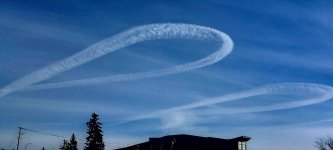
This photo was taken in Coquitlam BC in November of 2023 looking South towards Washington State. The loops are at the Can/USA border about 30km as the crow flies.
150km south from the spot the photo taken is Everret Washington which is home to the nuke missile packing US Navy Trident submarine fleet.
It makes perfect sense to obscure the view of Ruskie and Chinaman satellites when the Tridents are leaving port to points unknown. Puget Sound and Juan d Fuca Strait aren't as deep as the open ocean and would be relatively easy to spot.
As for the reverse I mentioned, movement of bombers, fighters, cargo and refueling aircraft could potentially be obscured by flying inside the chemtrails to be hidden from both above and below.
Perhaps the birds were concerned with ICE coming to check for green cards?Some of the comments are interesting.
Speaking of...what the flock?!
- YouTube
Enjoy the videos and music you love, upload original content, and share it all with friends, family, and the world on YouTube.
 www.youtube.com
it's long so speed it up
Last edited: