The Tarriff Hype.

Ron in Regina

"Voice of the West" Party
Apr 9, 2008
32,370
11,720
113
Regina, Saskatchewan
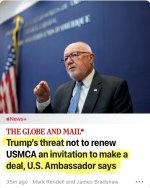
Wow, this Dude isn’t exactly Ambassador material, but more so an out of touch Dick. U.S. Ambassador Pete Hoekstra interviewed in Ottawa. Does Hoekstra understand the frustration of Canadians who feel they don't deserve this treatment from their country's largest trading partner, neighbour and ally?
51st State!” Trump wrote on social media. The jab was then retweeted by U.S. Ambassador to Canada, Pete Hoekstra, because Ambassador?

Ontario Premier Doug Ford is pushing back against U.S. President Donald Trump’s latest attack on Canada’s sovereignty.

“I can’t believe I have to say this again, but Canada will never be the 51st state,” Ford wrote in a post on X Tuesday morning.
Trump’s “51st state” rhetoric has been ongoing since December 2024. Although it was first seen as a joke, (?) it later developed into a real threat amid the ongoing trade war. Trump has since touted the economic benefits Canada would receive by becoming part of the U.S. and has referred to the border as an “artificial line.” Trump has made similar remarks about Venezuela.
 
  • Like
Reactions: Taxslave2

55Mercury

rigid member
May 31, 2007
4,451
1,108
113
That's right, dougie, because there are 10 provinces and 3 territories, meaning if it should ever happen we would become the 51st through 63rd States.
Just add 13 little maple leafs to the 50 stars on Old Glory.

Though I'm not in favour of any particular province separating unilaterally without a nation wide referendum of 50%+1 allowing them to do so.
But we know how such polls and elections can be rigged, so there's that...
 

Ron in Regina

"Voice of the West" Party
Apr 9, 2008
32,370
11,720
113
Regina, Saskatchewan
The USTR probe, conducted under Section 301 of the Trade Act of 1974, found that six countries have failed to effectively enforce existing laws prohibiting goods made with forced labor: Canada, Ecuador, the European Union, Indonesia, Mexico and Pakistan. The report recommended a 10 percent duty.

The other 44 countries investigated in the USTR probe are set to face a 12.5 percent tariff rate, including major trading partners like Japan and South Korea. The result will be a tariff level slightly lower than what Trump imposed last year under the International Emergency Economic Powers Act. But it marks an increase from the temporary 10 percent global tariff the U.S. currently has in place, which Trump imposed after the Supreme Court struck down his other duties.

Who pays the Trump tariffs? Americans…
1780492515664.jpeg
The USTR is also investigating 15 countries over excess manufacturing capacity, including Bangladesh, Cambodia, China, the European Union, Indonesia, Japan, Malaysia, Mexico, Norway, Singapore, South Korea, Switzerland, Taiwan, Thailand and Vietnam.
 

petros

The Central Scrutinizer
Nov 21, 2008
120,787
14,977
113
Low Earth Orbit
The USTR probe, conducted under Section 301 of the Trade Act of 1974, found that six countries have failed to effectively enforce existing laws prohibiting goods made with forced labor: Canada, Ecuador, the European Union, Indonesia, Mexico and Pakistan. The report recommended a 10 percent duty.

The other 44 countries investigated in the USTR probe are set to face a 12.5 percent tariff rate, including major trading partners like Japan and South Korea. The result will be a tariff level slightly lower than what Trump imposed last year under the International Emergency Economic Powers Act. But it marks an increase from the temporary 10 percent global tariff the U.S. currently has in place, which Trump imposed after the Supreme Court struck down his other duties.

Who pays the Trump tariffs? Americans…
View attachment 34606
The USTR is also investigating 15 countries over excess manufacturing capacity, including Bangladesh, Cambodia, China, the European Union, Indonesia, Japan, Malaysia, Mexico, Norway, Singapore, South Korea, Switzerland, Taiwan, Thailand and Vietnam.
Are you hoping Americans will be able to vote themselves out of Fascism?

America is dead.
 

Ron in Regina

"Voice of the West" Party
Apr 9, 2008
32,370
11,720
113
Regina, Saskatchewan
The USTR probe, conducted under Section 301 of the Trade Act of 1974, found that six countries have failed to effectively enforce existing laws prohibiting goods made with forced labor: Canada, Ecuador, the European Union, Indonesia, Mexico and Pakistan. The report recommended a 10 percent duty.
(YouTube & Whoopsies, Canada just got lectured on forced labour by a country with 12-cent prison wages)
 
  • Like
Reactions: Taxslave2

bob the dog

Council Member
Aug 14, 2020
2,094
1,414
113
Some things never change; I wonder how many in Quebec and how many across the country?

Melanie Jolie going on about something.

Thanks to the Government of Canada's investment, this major project is expected to maintain 5,000 full-time well-paying jobs in Quebec and across the country, while supporting 20 co-op student placements across Rio Tinto's operations in Canada. This investment is about protecting Canadian workers today, and at the same time, investing in the talent of tomorrow.
 

Ron in Regina

"Voice of the West" Party
Apr 9, 2008
32,370
11,720
113
Regina, Saskatchewan
Last week, the United States Trade Representative (USTR) launched investigations into 60 economies under Section 301(b) of the U.S. Trade Act of 1974 to determine whether they have failed to impose or enforce bans on imports produced with forced labour. But critics in the Washington beltway say the 301 probes are basically a “show trial” and that the verdict is sure to go against trading partners such as Canada.
Canada is facing the prospect of entirely new tariffs from U.S. President Donald Trump’s administration after Washington claimed Ottawa has a poor track record on preventing importation of products of forced labour.
1780624267805.jpeg
The move comes as Canada’s biggest free trade pact, CUSMANAFTAUSMCALMNOP, is up for renewal.
Canada and Mexico, two of America’s biggest trading partners, are being grouped together with China and dozens of other countries for these investigations. The probes will examine whether Ottawa’s forced-labour rules and framework, including the 2023 Fighting Against Forced Labour and Child Labour in Supply Chains Act, are sufficient for screening goods produced by child or forced labour.
The last time Canada renegotiated the continental free trade agreement, during the first Trump administration, Ottawa changed the wording in a customs law on forced labour rules in 2020. The White House says that since then, there has been little evidence Canada has stepped up enforcement.
“This has nothing to do with forced labour,” said Inu Manak, senior fellow for international trade at the Council on Foreign Relations.

She explained that these and the other probes recently launched by the administration also under Section 301 — looking at allegations of structural overcapacity and excessive production of major products like autos, steel and semiconductors — are part of an effort to rebuild the IEEPA tariff wall as comprehensively as possible, covering more than 70 countries.
The office of the United States Trade Representative accused Canada and a host of other countries of failing to enforce bans on forced labour in a new report released late Tuesday.
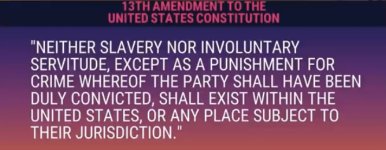
The 13th Amendment to the United States Constitution officially abolished slavery and involuntary servitude across the country. Ratified on December 6, 1865, it permanently outlawed the ownership of enslaved people, with the specific exception of penal labor for those duly convicted of a crime.🤔Hmmmm….
The U.S. Supreme Court struck down tariffs imposed under the International Emergency Economic Powers Act this year, a law the president used for Trump’s “Liberation Day” tariffs and fentanyl-related duties on Canada so…Prime Minister Mark Carney said Wednesday this action (the forced labour farcical accusations by America against everybody except for itself) did not come as a surprise and was something the U.S. had been planning and publicly discussing for months.
Investigations under the section, which follow a formalized process of consultations and hearings, usually take around 12 months to complete. But U.S. trade officials have already said they expect the probes to be completed within five months so that new tariffs can replace the time-limited Section 122 duties.
This means the conclusion of the 301 investigation into Canada could coincide with this summer’s USMCA review.
Following release of the U.S. report, the prime minister said while Canada already has some strong measures, the Liberal government will introduce new legislation to step up the fight against forced labour. Products made in the United States using forced or low-wage prison labor span a vast, multi-billion-dollar market. These products range from standard government-issued goods to agricultural commodities deeply embedded in the supply chains of popular consumer brands.

“We don’t want any element of forced labour coming in, goods and services, and we want to use our influence to eliminate this practice of forced labour and child labour,” Carney said in brief remarks to reporters.
Some examples of forced labour goods that U.S. prisoners produce that wind up in the supply chains of a dizzying array of products found in most American kitchens, from Frosted Flakes cereal and Ball Park hot dogs to Gold Medal flour, Coca-Cola and Riceland rice. They are on the shelves of virtually every supermarket in America, including Kroger, Target, Aldi and Whole Foods. And some goods are exported, including to countries that have had products blocked from entering the U.S. for using forced or prison labor.😲
 
  • Like
Reactions: Taxslave2

petros

The Central Scrutinizer
Nov 21, 2008
120,787
14,977
113
Low Earth Orbit
Canada is facing the prospect of entirely new tariffs from U.S. President Donald Trump’s administration after Washington claimed Ottawa has a poor track record on preventing importation of products of forced labour.
View attachment 34635
The move comes as Canada’s biggest free trade pact, CUSMANAFTAUSMCALMNOP, is up for renewal.

The last time Canada renegotiated the continental free trade agreement, during the first Trump administration, Ottawa changed the wording in a customs law on forced labour rules in 2020. The White House says that since then, there has been little evidence Canada has stepped up enforcement.

The office of the United States Trade Representative accused Canada and a host of other countries of failing to enforce bans on forced labour in a new report released late Tuesday.
The 13th Amendment to the United States Constitution officially abolished slavery and involuntary servitude across the country. Ratified on December 6, 1865, it permanently outlawed the ownership of enslaved people, with the specific exception of penal labor for those duly convicted of a crime.🤔Hmmmm….
The U.S. Supreme Court struck down tariffs imposed under the International Emergency Economic Powers Act this year, a law the president used for Trump’s “Liberation Day” tariffs and fentanyl-related duties on Canada so…Prime Minister Mark Carney said Wednesday this action (the forced labour farcical accusations by America against everybody except for itself) did not come as a surprise and was something the U.S. had been planning and publicly discussing for months.


Following release of the U.S. report, the prime minister said while Canada already has some strong measures, the Liberal government will introduce new legislation to step up the fight against forced labour. Products made in the United States using forced or low-wage prison labor span a vast, multi-billion-dollar market. These products range from standard government-issued goods to agricultural commodities deeply embedded in the supply chains of popular consumer brands.

“We don’t want any element of forced labour coming in, goods and services, and we want to use our influence to eliminate this practice of forced labour and child labour,” Carney said in brief remarks to reporters.
Some examples of forced labour goods that U.S. prisoners produce that wind up in the supply chains of a dizzying array of products found in most American kitchens, from Frosted Flakes cereal and Ball Park hot dogs to Gold Medal flour, Coca-Cola and Riceland rice. They are on the shelves of virtually every supermarket in America, including Kroger, Target, Aldi and Whole Foods. And some goods are exported, including to countries that have had products blocked from entering the U.S. for using forced or prison labor.😲
So no Minnesota Mukluks allowed?
 

Ron in Regina

"Voice of the West" Party
Apr 9, 2008
32,370
11,720
113
Regina, Saskatchewan
So no Minnesota Mukluks allowed?
Depends who makes them & how much, if at all, they’ve been paid, or if they’re made with forced labour I guess. We don’t want to be punished by the US for allowing products into Canada made with forced labour in the US, and I’d assume the other 60-ish countries that Trump is trying to target here also do not wish to be punished for purchasing products from the US with American forced labour.
Vietnam's foreign ministry said on Thursday that the U.S. Trade Representative's conclusion that it had failed to curb trade in goods made with ‌forced labour does not fully or accurately reflect Vietnam's mitigation efforts.

Vietnam is being targeted by the Trump administration ⁠for allegedly distorting trade with excess capacity, intellectual property violations and the use of goods from forced labour.
(YouTube & US announces new tariffs on Canada, dozens of other countries over forced labour concerns)
YouTube & ‘It’s all malarkey, but it’s the game they’re going to play’: Mulcair on Trump’s new tariffs)
 

Taxslave2

Senate Member
Aug 13, 2022
5,750
3,071
113
Some things never change; I wonder how many in Quebec and how many across the country?

Melanie Jolie going on about something.

Thanks to the Government of Canada's investment, this major project is expected to maintain 5,000 full-time well-paying jobs in Quebec and across the country, while supporting 20 co-op student placements across Rio Tinto's operations in Canada. This investment is about protecting Canadian workers today, and at the same time, investing in the talent of tomorrow.
Is that part of our sovereign wealth fund created with borrowed money?