Omnibus Russia Ukraine crisis

Ron in Regina

"Voice of the West" Party
Apr 9, 2008
33,301
11,946
113
Regina, Saskatchewan
Trump is as close as you can get to the Anti-Christ, or Damien Thorn, or Randal Flagg.
This man is bent on destroying the United States and taking every dime his personal oligarchy can fleece.
Are Trump supporters that fucking brainwashed?
It's mind-boggling.
Could it be a “forest for the trees” situation at least for a percentage of the American population?
 
  • Like
Reactions: Retired_Can_Soldier

Retired_Can_Soldier

The End of the Dog is Coming!
Mar 19, 2006
12,684
1,561
113
61
Alberta
Could it be a “forest for the trees” situation at least for a percentage of the American population?
Could it be that the Democrats are almost as fucked in the head, but in other ways?
Your first tribe is always your family, and when you can't feed or house them, it's much easier to walk away from a political party.
 
  • Like
Reactions: Ron in Regina

Ron in Regina

"Voice of the West" Party
Apr 9, 2008
33,301
11,946
113
Regina, Saskatchewan
Russian President Vladimir Putin said on Thursday that future talks on a settlement of the war in Ukraine (that Putin started) should focus on security guarantees for both countries and an overall framework for security throughout Europe.
Putin, interviewed on Russian ‌television a day after meeting US presidential Golf Buddy Steve Witkoff, confirmed that Russia was ready to resume US-mediated talks with Ukraine next month (after the US midterm elections). He restated longstanding Kremlin policy that Russia never wanted to launch a war, but had run into hostile reactions from Ukraine on key issues of concern (like a lack of capitulation) to Moscow.
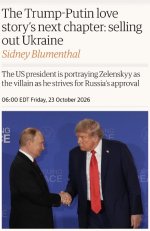
On Monday, President Trump said he would accept Mr. Putin’s invitation to meet next month with him and Chinese leader Xi Jinping to resolve the war in Ukraine. Notably absent from the confab would be Mr. Zelenskyy, whose country Mr. Putin is seeking to carve up and weaken.
Many of the Ukraine war issues focus on territory, with Russia demanding Ukraine cede all of eastern Ukraine's Donbas region. Kyiv rejects any notion of giving up land it currently holds. In his comments, ⁠Putin said any discussion on territory in eastern Ukraine had to consider what he said was the fact that the area was "historically Russian land".
Under modern international law, imperial or historical ownership does not grant a country the right to rewrite modern sovereign borders. Ukraine’s borders were internationally recognized when it declared independence from the Soviet Union in 1991—a declaration that was backed by over 90% of Ukrainian voters, including strong majorities in the eastern oblasts.
Furthermore, Russia explicitly committed to respecting and protecting Ukraine's existing borders in the 1994 Budapest Memorandum in exchange for Ukraine giving up its nuclear arsenal. Ultimately, Russia’s attempt to claim eastern Ukraine relies on a "might makes right" philosophy. On paper, the Kremlin has integrated these regions into its constitution; however, Russian forces have never fully controlled the four provinces they claim to own, making the annexation unrecognized both in international law and on the physical battlefield.
 

Ron in Regina

"Voice of the West" Party
Apr 9, 2008
33,301
11,946
113
Regina, Saskatchewan
US first lady Melania Trump has secured a ceasefire between Russia and Ukraine in the Russian-controlled city of Oleshky, which will begin on October 29, the White House ‌said on Friday?

I wonder if either Russia or Ukraine are aware of this?
In an interview with Kremlin journalist Pavel Zarubin, Putin stated that Russians and Ukrainians share genetic and historical unity. He argued that Ukrainian territories annexed by Russia—such as Zaporizhzhia, Kherson, Donetsk, and Luhansk—are the "historical territory of Russia" rather than true Ukrainian land. Putin did not name the scientific works or provide any specific data or evidence to back up his genetic assertions.
1792771877917.jpegThe remarks align with Putin's longstanding narrative, including his 2021 essay On the Historical Unity of Russians and Ukrainians, which claims that modern Ukrainian identity and statehood are artificial creations similiar to Trump’s claims about the Canadian border and sovereignty.
 

Ron in Regina

"Voice of the West" Party
Apr 9, 2008
33,301
11,946
113
Regina, Saskatchewan
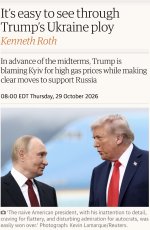
Putin has proposed a meeting with Trump and Xi Jinping to settle the Ukraine war on Russian terms without the presence of the troublesome Ukrainian president, Volodymyr Zelenskyy. The Wall Street Journal described such a meeting as “unprecedented”. As a historical matter, that would be untrue. The Czechs were not present at Munich when their country was delivered to Hitler😳.
1792792190920.jpeg
Part of Trump’s urgent reason for selling out Ukraine is to cast blame before the midterm elections for the inflation wrought by his tariffs and Iran war. Panicked by plunging polls, he has ramped up his rhetoric against Zelenskyy as the alleged source of the crisis that Trump himself has created.

Another part according to Fiona Hill, who served as Trump’s director for Russian affairs on the national security council in his first term, has described Trump as awestruck in his relationship with Putin. Trump envied him as the “ultimate badass”. She observed how Trump’s pathetic need to be seen as a peer to the autocrat allowed him to be played like a fiddle.

At the 2018 Helsinki summit, she was horrified when Trump dismissed the findings of the US intelligence community that Russia had interfered in the presidential election of 2016 on his behalf, deferring to Putin by saying: “President Putin says it’s not Russia. I don’t see any reason why it would be.”
 

petros

The Central Scrutinizer
Nov 21, 2008
121,394
15,155
113
Low Earth Orbit
Putin has proposed a meeting with Trump and Xi Jinping to settle the Ukraine war on Russian terms without the presence of the troublesome Ukrainian president, Volodymyr Zelenskyy. The Wall Street Journal described such a meeting as “unprecedented”. As a historical matter, that would be untrue. The Czechs were not present at Munich when their country was delivered to Hitler😳.
View attachment 36021
Part of Trump’s urgent reason for selling out Ukraine is to cast blame before the midterm elections for the inflation wrought by his tariffs and Iran war. Panicked by plunging polls, he has ramped up his rhetoric against Zelenskyy as the alleged source of the crisis that Trump himself has created.

Another part according to Fiona Hill, who served as Trump’s director for Russian affairs on the national security council in his first term, has described Trump as awestruck in his relationship with Putin. Trump envied him as the “ultimate badass”. She observed how Trump’s pathetic need to be seen as a peer to the autocrat allowed him to be played like a fiddle.

At the 2018 Helsinki summit, she was horrified when Trump dismissed the findings of the US intelligence community that Russia had interfered in the presidential election of 2016 on his behalf, deferring to Putin by saying: “President Putin says it’s not Russia. I don’t see any reason why it would be.”
Trump doesnt want to be blamed for a global depression due to an energy crisis even though this was on Bibi.

It started. By spring the entire globe is fucked. He needs Russian oil flowing.
 
Last edited:

Ron in Regina

"Voice of the West" Party
Apr 9, 2008
33,301
11,946
113
Regina, Saskatchewan
Trump doesnt want to be blamed for a global depression due to an energy crisis even though this was on Bibi.

It started. By spring the entire globe is fucked. He needs Russian oil flowing.
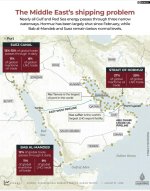
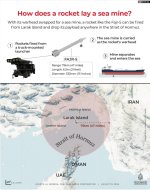
1792868937209.jpegGood times. Iran's Islamic Revolutionary Guard Corps Navy said ‌on Thursday that four vessels involved in illegal oil transfers in the northern ⁠Persian Gulf were simultaneously hit and caught fire after being tracked by its forces on Wednesday. Geography is on Iran’s side as it can fire at ships in the Strait of Hormuz from ground positions along its coast. It can also place sea mines in the strait using rockets to drop them, so it doesn’t even need a navy to fight this sea battle.
1792870350724.jpegAs predicted decades in advance, the Strait of Hormuz between Iran and Oman, which had been freely open to international shipping before the war, now gives Tehran a means of imposing costs far beyond its borders. Donald Trump’s fuel agreement with Vladimir Putin cannot offset the lost oil and diesel caused by the conflict in the Middle East.

Energy experts and market analysts point to major mathematical and logistical deficits that make the deal largely symbolic rather than a true fix for the global energy crisis. with subsequent planned shipments—500,000 metric tons in November and a potential 1 million tons afterward—the amounts remain too insignificant to close the massive gap left by disrupted Middle Eastern supply lines, so this is smoke & mirrors to normalize Russian trade for other reasons.
1792869064415.jpeg
The IRGC added that three ‌more ⁠vessels collided with mines west of the Strait of Hormuz, and ⁠warned the US military that continued provocations could ⁠lead to a wider response ⁠against its regional bases.

The Trump administration has claimed that the entire series of strikes is fabricated (fake news?) or at least exaggerated, with Trump himself lashing out on Truth Social and saying, “They are making up fake hits, mines, and everything else because more oil is coming through the Hormuz Strait now than it did even prior to the beginning of the conflict.”🙄
Although analysts consider a US attack before the November 3 midterm elections unlikely, sabre-rattling on both sides has raised fears that escalating rhetoric could give way to renewed attacks with control of the Strait of Hormuz and Iranian nuclear facilities in which talks over Iran’s nuclear programme were under way at the end of February are at the heart of the conflict.Trump faces much tougher political pressure before any renewed strikes.
1792869751264.jpeg
Unlike in February before the war began, the US and Iran would be fighting it out on several different fronts if attacks resume, with Hezbollah’s retaliation against targets in northern Israel after the killing of Iranian Supreme Leader Ali Khamenei in the first US-Israeli air strikes brought Lebanon into the war in early March. A mounting global energy crisis was not on the cards in February, but it is certainly looming now, so this is ‘obviously’ the fault of Ukrainian President Zelenskyy.🤔

The biggest geographical change, however, has been the emergence of the Gulf’s waterways and energy infrastructure as key targets. Iranian attacks on US military assets and civilian infrastructure have exposed Gulf countries to the consequences of a war they had hoped to avoid. While the Gulf has experienced attacks before, the scale and “velocity” of recent Iranian strikes, including on oil and gas infrastructure, have marked a significant shift.

Renewed fighting between the forces of the Saudi-backed, internationally recognised government of Yemen and the Iran-backed Houthis has added another front to the regional crisis.
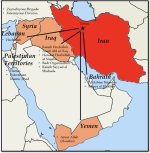
1792871740109.jpeg Yemen’s war has expanded to Saudi Arabia as Houthi missile and drone attacks target Saudi airports and oil infrastructure. Almost immediately after Israel and the US started attacking Iran on February 28, Tehran began disrupting the flow of energy products through the Strait of Hormuz – sending oil and gas prices skyrocketing, and now there’s another choke point of a strait in the Middle East
1792871433604.jpegWhile the US has demonstrated its ability to strike deep inside Iran (hit & retreat), that destructive capacity has not brought down Iran’s political system nor has it finished off Tehran’s ability to retaliate with strikes on US assets and energy infrastructure in neighbouring countries, demonstrating the difficulty for Washington in “translating military superiority into strategic results”.

Trump, who is the leader of the Republican Party, has suggested that he may renew all-out fighting with Iran after the midterm vote next month, and he has promoted the war as a historic success with the increased cost of energy and transportation that has trickled down to the entire economy globally fuelling inflation at a time when affordability had become one of the key issues in US electoral politics.
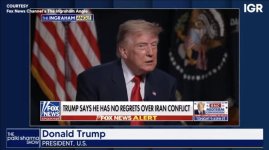
1792871677208.jpeg“I think it’s one of the greatest things we’ve done. We’ve stopped Iran from having a nuclear weapon,” that Trump himself had said repeatedly that Iran’s nuclear programme had been “obliterated” by the June 2025 US strikes against the country’s uranium enrichment facilities, told reporters on Wednesday. US intelligence officials have testified to Congress that they have no evidence that Iran is building a nuclear bomb. “It’s one of the best things that we’ve done, and it took a lot of courage to do it because no other president was willing to do it.” Despite the overall unpopularity of the war, most Republicans continue to support it.
Trump has seemingly instructed the Pentagon to more or less curtail its aggressive forays within Iran, maybe hoping that if he simply runs out the clock to some kind of Republican midterm victory (or a draw, like retaining the Senate) that Iran will be more receptive to new talks after the election.

Or at least, that’s what Trump has often claimed, saying things like “I believe we’ll make a deal right after the election,” and “I gave absolutely no credence and will not give credence to the election when it comes to Iran; it doesn’t even enter my mind.” It would have a certain logic for the Iranians to figure that if they’re just sitting around waiting for the U.S. to renew its strikes after the midterms, they may as well take the initiative to strike first, before the midterms. Iran clearly had no intention of participating in that campaign to give Republicans the best possible shot to hold off a surging blue wave. You don’t need to look any farther than the price of a barrel of Brent Crude to see that.
 

petros

The Central Scrutinizer
Nov 21, 2008
121,394
15,155
113
Low Earth Orbit
View attachment 36026Good times. Iran's Islamic Revolutionary Guard Corps Navy said ‌on Thursday that four vessels involved in illegal oil transfers in the northern ⁠Persian Gulf were simultaneously hit and caught fire after being tracked by its forces on Wednesday. Geography is on Iran’s side as it can fire at ships in the Strait of Hormuz from ground positions along its coast. It can also place sea mines in the strait using rockets to drop them, so it doesn’t even need a navy to fight this sea battle.
View attachment 36029As predicted decades in advance, the Strait of Hormuz between Iran and Oman, which had been freely open to international shipping before the war, now gives Tehran a means of imposing costs far beyond its borders. Donald Trump’s fuel agreement with Vladimir Putin cannot offset the lost oil and diesel caused by the conflict in the Middle East.

Energy experts and market analysts point to major mathematical and logistical deficits that make the deal largely symbolic rather than a true fix for the global energy crisis. with subsequent planned shipments—500,000 metric tons in November and a potential 1 million tons afterward—the amounts remain too insignificant to close the massive gap left by disrupted Middle Eastern supply lines, so this is smoke & mirrors to normalize Russian trade for other reasons.
View attachment 36027
The IRGC added that three ‌more ⁠vessels collided with mines west of the Strait of Hormuz, and ⁠warned the US military that continued provocations could ⁠lead to a wider response ⁠against its regional bases.

The Trump administration has claimed that the entire series of strikes is fabricated (fake news?) or at least exaggerated, with Trump himself lashing out on Truth Social and saying, “They are making up fake hits, mines, and everything else because more oil is coming through the Hormuz Strait now than it did even prior to the beginning of the conflict.”🙄
Although analysts consider a US attack before the November 3 midterm elections unlikely, sabre-rattling on both sides has raised fears that escalating rhetoric could give way to renewed attacks with control of the Strait of Hormuz and Iranian nuclear facilities in which talks over Iran’s nuclear programme were under way at the end of February are at the heart of the conflict.Trump faces much tougher political pressure before any renewed strikes.
View attachment 36028
Unlike in February before the war began, the US and Iran would be fighting it out on several different fronts if attacks resume, with Hezbollah’s retaliation against targets in northern Israel after the killing of Iranian Supreme Leader Ali Khamenei in the first US-Israeli air strikes brought Lebanon into the war in early March. A mounting global energy crisis was not on the cards in February, but it is certainly looming now, so this is ‘obviously’ the fault of Ukrainian President Zelenskyy.🤔

The biggest geographical change, however, has been the emergence of the Gulf’s waterways and energy infrastructure as key targets. Iranian attacks on US military assets and civilian infrastructure have exposed Gulf countries to the consequences of a war they had hoped to avoid. While the Gulf has experienced attacks before, the scale and “velocity” of recent Iranian strikes, including on oil and gas infrastructure, have marked a significant shift.

Renewed fighting between the forces of the Saudi-backed, internationally recognised government of Yemen and the Iran-backed Houthis has added another front to the regional crisis.
View attachment 36032 Yemen’s war has expanded to Saudi Arabia as Houthi missile and drone attacks target Saudi airports and oil infrastructure. Almost immediately after Israel and the US started attacking Iran on February 28, Tehran began disrupting the flow of energy products through the Strait of Hormuz – sending oil and gas prices skyrocketing, and now there’s another choke point of a strait in the Middle East
View attachment 36030While the US has demonstrated its ability to strike deep inside Iran (hit & retreat), that destructive capacity has not brought down Iran’s political system nor has it finished off Tehran’s ability to retaliate with strikes on US assets and energy infrastructure in neighbouring countries, demonstrating the difficulty for Washington in “translating military superiority into strategic results”.

Trump, who is the leader of the Republican Party, has suggested that he may renew all-out fighting with Iran after the midterm vote next month, and he has promoted the war as a historic success with the increased cost of energy and transportation that has trickled down to the entire economy globally fuelling inflation at a time when affordability had become one of the key issues in US electoral politics.
View attachment 36031“I think it’s one of the greatest things we’ve done. We’ve stopped Iran from having a nuclear weapon,” that Trump himself had said repeatedly that Iran’s nuclear programme had been “obliterated” by the June 2025 US strikes against the country’s uranium enrichment facilities, told reporters on Wednesday. US intelligence officials have testified to Congress that they have no evidence that Iran is building a nuclear bomb. “It’s one of the best things that we’ve done, and it took a lot of courage to do it because no other president was willing to do it.” Despite the overall unpopularity of the war, most Republicans continue to support it.
Trump has seemingly instructed the Pentagon to more or less curtail its aggressive forays within Iran, maybe hoping that if he simply runs out the clock to some kind of Republican midterm victory (or a draw, like retaining the Senate) that Iran will be more receptive to new talks after the election.

Or at least, that’s what Trump has often claimed, saying things like “I believe we’ll make a deal right after the election,” and “I gave absolutely no credence and will not give credence to the election when it comes to Iran; it doesn’t even enter my mind.” It would have a certain logic for the Iranians to figure that if they’re just sitting around waiting for the U.S. to renew its strikes after the midterms, they may as well take the initiative to strike first, before the midterms. Iran clearly had no intention of participating in that campaign to give Republicans the best possible shot to hold off a surging blue wave. You don’t need to look any farther than the price of a barrel of Brent Crude to see that.
What navy? Wasnt it gone day 1?

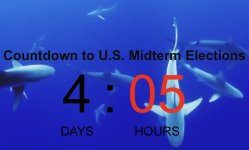
Speaking of elections...

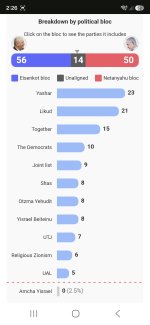
399.jpg

Hes got a week to really fuck things up.
 

Taxslave2

Senate Member
Aug 13, 2022
5,990
3,188
113
If even a half of the tankers claimed were actually damaged the entire sea and shoreline would be a gooy black mess.
 

Ron in Regina

"Voice of the West" Party
Apr 9, 2008
33,301
11,946
113
Regina, Saskatchewan
Are the Straight Hormones open?
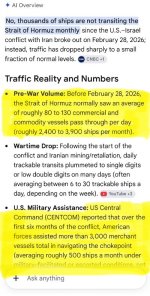
Depends on whom you ask. Maritime insurance and war-risk underwriters do not consider the Strait of Hormuz fully open or normal, though war-risk coverage remains technically available under strict conditions and elevated pricing.

U.S. & International Position: The U.S. Central Command (CENTCOM) states that the strait is open and clear of Iranian sea mines, with more than 95% of commercial vessels safely transiting with support from U.S. forces.

Iranian Position: The Islamic Revolutionary Guard Corps (IRGC) and Iranian officials maintain that the strait is officially closed and require transit permits under a list of conditions, though Iran has also indicated a conditional readiness to fully reopen if a U.S. blockade is lifted.

On-the-Ground Reality Apparently: Despite active maritime attacks and high regional tensions—including a record number of ship attacks in October 2026—thousands (???) of commercial vessels and oil tankers continue to pass through the waterway.
1792972280931.jpeg
 

Ron in Regina

"Voice of the West" Party
Apr 9, 2008
33,301
11,946
113
Regina, Saskatchewan
Sen. Mitch McConnell (R-Ky.), who had been largely quiet on the issue of the war after Ukraine lost full access to the satellite-based Starshield network, which provoked an uproar in Washington, is now speaking out forcefully against Trump’s handling of the conflict.
McConnell, the chair of the Senate Appropriations Subcommittee on Defense, blasted Trump for claiming that Russia “has been fine on Ukraine” when the president was asked about Russian violations of an energy ceasefire. “This is factually wrong, strategically naive and morally bankrupt. His obsequious accommodation of Russia, rewarding the aggressor with sanctions relief, won’t persuade Mr. Putin to stop. History shows that such behavior emboldens Russia’s autocrat, who sees it as weakness,” he wrote in an op-ed published Sunday by The Wall Street Journal.
 
  • Like
Reactions: Taxslave2

Ron in Regina

"Voice of the West" Party
Apr 9, 2008
33,301
11,946
113
Regina, Saskatchewan
1793325655887.jpeg
1793325674288.jpeg

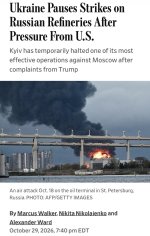
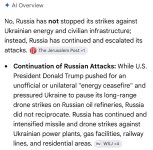
Ukraine’s government hasn’t announced a pause in refinery strikes. Zelensky has said Ukraine wants more protection for its own energy infrastructure—which Russia has been systematically destroying with missile and drone attacks ahead of winter—in exchange for holding off.

But Russia is continuing to escalate its missile and drone attacks on Ukraine’s energy infrastructure and its cities, inflicting a mounting civilian death toll while Trump is trying to blame the inflationary surge in US gasoline and diesel prices on these Ukrainian retaliatory attacks, even though their effect on the global market is small compared with the diminished flow through the strait of Hormuz.
1793325694944.jpeg
The unofficial pause, which is expected to last until after the U.S. midterm elections but potentially deeper into November, began early last week at the height of a crisis in U.S.-Ukrainian relations, the people said. Days earlier, Trump had called for the removal of Ukrainian President Volodymyr Zelensky and Elon Musk’s SpaceX had limited Ukraine’s use of Starlink.
1793326866167.jpeg
The US upped the pressure on its ostensible allies as part of its push for a truce in the Russia-Ukraine war. Kyiv has paused its strikes on Russian refineries at the behest of Washington, which is trying to corral runaway fuel prices, The Wall Street Journal reported, while Reuters said the Pentagon had urged European leaders to calm their rhetoric over the threat of Russian aggression.
The moves come as Russia’s foreign minister entered the US to attend a meeting of G20 foreign ministers, and after the Trump administration waived new sanctions on Russian energy and reached a diesel deal with the Kremlin — decisions met with unease in Europe, which sees Washington as unnecessarily pressuring Kyiv.
 

Ron in Regina

"Voice of the West" Party
Apr 9, 2008
33,301
11,946
113
Regina, Saskatchewan
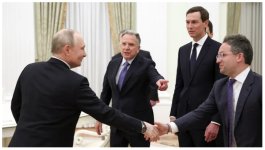
Trump’s announcement also came just as Ukrainian negotiators departed for the U.S., for a new round of talks aimed at bringing an end to the war with Russia. Special envoy Steve Witkoff and President Donald Trump’s son-in-law Jared Kushner had been expected to lead the discussions. It was unclear late Friday whether they would continue as planned in light of the latest sanctions waiver.
1793839301017.jpeg
Russian presidential aide Yuri Ushakov, speaking later to reporters, wouldn’t say whether the U.S. made any concessions in exchange for the supplies, or what, if anything, was promised to Russia (???) in exchange? The law Trump signed last month envisions sanctions on Russian officials, banks and a shadow fleet of tankers and bans all new U.S. investment in Russia and the handling of sovereign debt.
1793839402311.jpeg
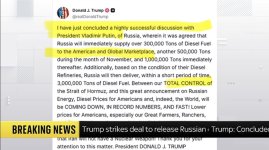
Unlike his public pressure on Ukrainian President Volodymyr Zelenskyy to halt strikes on Russian oil refineries (driven by concerns over global diesel and fuel prices), Trump’s public statement to Moscow did not outline a specific retaliatory consequence or threat directed at Putin, even as reports confirmed Russian forces continued striking Ukrainian power and gas infrastructure.🤫
Donald Trump has put on hold a sweeping new sanctions package targeting the Russian economy, telling Congress the pause on the legislation passed by both chambers was in the national interest?
1793841319473.jpeg
If Congress uses those bills to ‌try to ⁠change his Russia policies, Trump could veto them, setting up a showdown. James Lindsay, a US foreign policy expert at the Council on Foreign Relations, said the Republican backlash was not surprising given the Senate's bipartisan votes on the Graham bill.
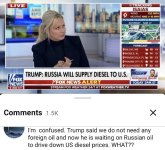
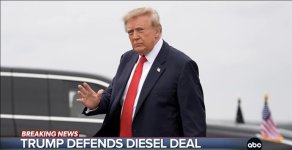
As three tankers carrying Russian diesel are crossing the Atlantic toward U.S. ports, with a fourth set to depart soon, President Donald Trump's fuel deal with Moscow is drawing opposition in Congress and threats to investigate companies involved in the shipments.
1793840309390.jpeg Only one of the three Russian diesel tankers is still heading to the United States.

According to vessel-tracking data and reports from November 3 and 4, 2026:
    • Agioi Fanendes: Remains en route to New York with an expected arrival around November 7, 2026, though its status has been listed as "awaiting instructions".
    • Talisman: Has entered the Mediterranean Sea and changed or diverted its course away from its original U.S. destination.
    • Leruo: Has changed course and redirected toward Brazil.
The shipments are (or were?) part of a high-profile agreement between President Donald Trump and Russian President Vladimir Putin to resume diesel shipments, which faced bipartisan domestic legal and political pushback—including warnings from lawmakers and state officials about ongoing federal prohibitions and sanctions under the Ending Importation of Russian Oil Act.🤔

U.S. companies have avoided purchasing the fuel due to severe legal and reputational risks. Although a temporary U.S. Treasury General License (License 135) was issued, it conflicts with the 2022 statutory ban (Ending Importation of Russian Oil Act).🙄

New Jersey Governor Mikie Sherrill and state authorities warned port operators and the Port Authority of New York and New Jersey against accepting the shipments, threatening multimillion-dollar fines and citing potential criminal and civil penalties.
Critics and lawmakers from both parties view the Trump-Putin diesel agreement as a stark reversal and an apparent contradiction of the Lindsey O. Graham Sanctioning Russia and Iran Act of 2026, which President Trump signed into law just three weeks prior on September 18, 2026.
1793841396256.jpegThe shipments—stemming from an October 9, 2026 agreement between Donald Trump and Vladimir Putin aimed at lowering fuel prices before the midterms—faced fierce opposition from lawmakers, bipartisan criticism, and a complete lack of willing commercial buyers at U.S. terminals.
 

Jinentonix

Hall of Fame Member
Sep 6, 2015
11,631
6,280
113
Olympus Mons
The "300,000" tonnes of diesel "flex" is hilarious. That's about 12 hours worth of diesel in the US. The entire 4.8 million tonne total would last about 12 minutes globally.
The demented jack-o-lantern has fucked gas and diesel prices for years to come. The damage and destruction to refining facilities in the Gulf region will take years to repair and replace. Chump could completely TACO on Iran tomorrow and gas and diesel prices still won't be coming down anytime soon. And now that he's lost both the House and Senate, he's got 2+ months to burn the world down with him, and he will try.
 

Ron in Regina

"Voice of the West" Party
Apr 9, 2008
33,301
11,946
113
Regina, Saskatchewan
Chump could completely TACO on Iran tomorrow and gas and diesel prices still won't be coming down anytime soon. And now that he's lost both the House and Senate, he's got 2+ months to burn the world down with him, and he will try.
A quick bombing campaign before January 3rd 2027, then a pull out with a declaration of victory leaving the Middle East & anyone that relies on that region for their energy needs to pick up the pieces, with a swing by Cuba on the way back to port in the US…& done deal?

I watched a short interview with the former governor of Minnesota Jesse Ventura who has a different perspective on Cuba than the current US president. Ventura happens to be a former Navy seal as opposed to a draft dodger, and he thinks Cuba would be problematic, even after having them starved for the last year, like a cross between Afghanistan and Vietnam.
 
  • Like
Reactions: Taxslave2

Ron in Regina

"Voice of the West" Party
Apr 9, 2008
33,301
11,946
113
Regina, Saskatchewan
Trump has sided with Putin all along. As soon as he was elected, Trump cut off all military aid to Ukraine and busied himself with Russia-Ukraine “mediation,” usually in the form of self-dealing contrivances pushed by Putin’s sanctioned slush-fund manager Kirill Dmitriev, Trump’s son-in-law Jared Kushner and Golf Buddy Steve Witkoff, Trump’s cofounder of the shadowy and immensely lucrative “stablecoin” racket known as World Liberty Financial.

More than once, Kushner, Witkoff and Dmitriev have colluded in efforts to challenge Europe’s control over the $245 billion in frozen Russian sovereign wealth funds locked down in the Euroclear securities depository in Belgium — funds that should be handed over to Ukraine in their entirety, as war reparations.

One of the trio’s more recent schemes: Another lifeline to Russia, this one by way of a plan to circumvent European sanctions on Russian natural gas that would enrich Russian suppliers and American investors alike in a U.S. venture to pump Russian gas through Ukrainian pipelines into European markets. The idea followed a related Witkoff-Kushner-Dmitriev plan to revive the Nord Stream 2 pipeline to carry Russian gas to Europe. The proposals landed with loud thuds in Kyiv and Brussels.

Europe has been struggling to free itself from energy dependence on Russia, which involved payments that amounted to 10 billion euros annually by the time Russia’s full-scale war on Ukraine began in 2022. By last year, Europe had reduced Russia’s share of its gas purchases to 12 per cent from 45 per cent. The EU is on target to end all gas imports from Russia over the next two years. All coal imports from Russia have been banned. Imports of Russian oil have shrunk from 27 per cent of overall imports to two per cent, and falling.

The Witkoff-Kushner-Dmitriev pipeline schemes would reverse all that. They were formulated as key to Trump’s unilateral Oct. 11 declaration of a Russia-Ukraine “energy ceasefire,” which Russia ignored, keeping up its attacks on Ukraine’s power plants. Ukraine bowed to U.S. pressure and paused strikes on Russian refineries for nearly two weeks, for nothing in return.

Trump’s interventions since January last year have consisted mostly of a series of shakedown operations weakening Kyiv along with endorsements of Russia’s demands: Ukraine must never be permitted to join NATO; Russia must be permitted to keep Crimea, which Moscow annexed in 2014, along with the territories Russia has seized in the Donbas region since 2022; Russia should be readmitted to the G7; Ukraine should be made to provide U.S. firms with upwards of $500 billion in rare earths and other mineral concessions; no European troops should be allowed to set foot in Ukraine in any post-war security arrangements. And on and on.

Trump sees Ukraine as an impediment to profitable Russian partnerships in Arctic mining ventures and various oil and gas ventures. Europe and Canada see Russia as a profoundly dangerous threat to democracy and sovereignty. Overwhelmingly, majorities in both houses of the U.S. Congress see Russia the same way. That can’t be a bad thing, can it?