


Since February 28, 2026 (the start of escalated US-Israeli strikes on Iran and Iran's subsequent de facto blockade/restrictions on the Strait of Hormuz), oil tanker traffic has plummeted to a small fraction of normal levels. Pre-conflict, the strait typically saw ~100–138 commercial vessels per day (including ~20 million barrels per day of crude oil and products, or roughly 20% of global seaborne oil trade). Post-Feb 28, transits dropped 90–97%, often to single digits daily, with many vessels using "dark" (AIS-off) transits, hugging Iranian waters, or requiring Iranian permission.fddad5Was that something you'd like to know?
I can find out as can you if you up your vocabulary as well as using a more comprehensive AI.
Shall we?
Approximate Number of Oil Tankers
Exact real-time counts vary by source and definition (crude vs. products/LNG tankers, AIS-on vs. dark fleet), and data is incomplete due to the chaotic environment, attacks on vessels, and selective access. Here's a synthesis from maritime analytics (Kpler, S&P Global, Lloyd’s List Intelligence, TankerTrackers, Bloomberg, etc.) as of mid-to-late March 2026:
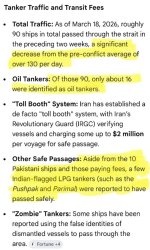
Early estimates (Feb 28 to ~March 18): Around 21 oil tankers (S&P Global). Kpler reported ~108 total vessels (not all tankers) in the initial period, dropping sharply to ~38 after March 2. Lloyd’s List noted ~89 ships (including ~16 oil tankers) from March 1–15.9415b0
Broader window (March 1 to ~March 24): Kpler tracked 94 oil and gas tanker crossings out of 149 total commodity carrier transits (a ~95% drop). Of these, ~61% were loaded, and more than two-thirds headed east (out of the Gulf toward the Gulf of Oman/Asia).dcfc18
Ongoing pattern (mid-to-late March): Daily transits often 2–9 vessels total, with oil/LNG tankers making up a portion (e.g., 5 tankers on some days). Iranian-linked or "friendly" (China-, India-, Pakistan-affiliated) vessels dominate the limited flow; Western/allied shipping is largely halted. Some days see near-zero. Cumulative tanker-specific figures likely range from low dozens to around 100 by late March, depending on inclusion of dark fleet and partial data.67c9f6
Hundreds to ~2,000 vessels (including many tankers) have been anchored or loitering on either side, waiting or diverting. Some attacks on ships near the strait have further deterred traffic.944956
Destinations
The vast majority of the limited oil flows through the strait since Feb 28 have been:
Primarily eastbound to Asia, especially China (the dominant buyer of Iranian crude, often via ship-to-ship transfers in Southeast Asia like off Malaysia/Singapore to obscure origins). India, Pakistan, and other Asian markets also feature in permitted transits.c9c116
Iranian oil accounts for most of the continuing exports (estimated 1.1–1.6 million barrels/day, sometimes higher in early March), with cargoes from Kharg Island and similar terminals. These often use sanctioned/"ghost fleet" tankers with AIS manipulation.
Rare non-Iranian examples: A Greek-operated tanker with Saudi oil bound for Mumbai, India; a Pakistan-flagged tanker (Karachi) with Abu Dhabi (Das) crude to Pakistan; occasional Iraq-linked or other Gulf cargoes to Asia. Some LNG or product tankers have diverted (e.g., Europe-bound rerouted to Asia).cf7ce8
Westbound (into the Gulf) transits are fewer and often involve ballast (empty) tankers or limited loadings. Overall pre-war pattern was ~84% of Hormuz crude/condensate heading to Asia (China ~38%, India, South Korea, Japan leading), and that skew has intensified for the surviving traffic.4c34a3
Context and Caveats
Iran's role: Iran has effectively turned the strait into a selective "toll booth," allowing its own exports and some from "friendly" nations (often after negotiations or payments) while restricting or attacking others. This has boosted Iran's relative oil revenue amid higher prices, even as regional exports from Saudi Arabia, UAE, Iraq, etc., have crashed (down 60%+ in some weeks).1a25fb
Data limitations: Figures rely on AIS signals, satellite, and analytics firms; dark fleet activity (common for Iranian oil) undercounts totals. Numbers evolve daily, and full verified counts require proprietary tools.
Impact: Global oil markets have seen volatility, with rerouting, insurance spikes, and production cuts in the Gulf.
For the most current snapshot, real-time trackers like MarineTraffic, Kpler, or specialized Hormuz monitors would provide updates beyond mid-March reporting. The situation remains fluid amid the broader conflict.


 )
)

