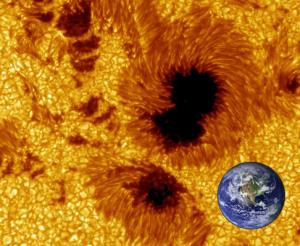
The mystery of sunspots

eanassir
#121
Quote: Originally Posted by WalterView Post

This is not news, it's speculation.

OK, it is almost the newspapers way of displaying things.

But what have lead them to speculate this?

Has their speculation any justified reason?
 
L Gilbert
Avatar
#122
Yep. The ice is retreating farther north. As to when/if it disappears altogether, tough to say.
 
Walter
Avatar
#123
A sun spot formed today. First one in about three weeks but it's a cycle 23 spot; still looking for cycle 24.
 
Walter
#124
Cycle 24 still isn't doing anything.
 
Walter
Avatar
#125
Cycle 24, where are you? (Sung to the theme of Car 54.)

 
Walter
Avatar
#126
Currently we have a sunspot, the first one in a month, but it is a cycle 23 spot. Oops, it didn't last long enough to be counted as a sun spot.
Last edited by Walter; Aug 31st, 2008 at 06:55 AM..
 
Walter
Avatar
#127
--

30 08 2008
Many people that have have an interest in the interaction between the Sun and Earth have been keeping a watchful eye on several metrics of solar activity recently. The most popular of course has been sunspot watching.
The sun has been particularly quiet in the last several months, so quiet in fact that Australia’s space weather agency recently revised their solar cycle 24 forecast, pushing the --.
On August 31st, at 23:59 UTC, just a little over 24 hours from now, we are very likely to make a bit of history. It looks like we will have gone an entire calendar month without a sunspot. According to data from NOAA’s National Geophysical Data Center, the last time that happened was in June of 1913. May of 1913 was also spotless.
With the current space weather activity level of the Sun being near zero, and the SOHO holographic imaging of the far side of the sun showing no developing spots that would come around the edge in the next 24 hours, it seems a safe bet to conclude that August 2008 will be the first spotless month since June 1913.
Some people who watch the sun regularly might argue that August wasn’t really spotless, because on August 21st, a very tiny plage area looked like it was going to become a countable sunspot.

But according to solar physicist Leif Svalgaard, who regularly frequents this blog:
According to NOAA it was not assigned a number on Aug.21st nor on Aug.22.
So without an official recognition or a number assigned, it should not be counted in August as actual sunspot.
It has also been over a month since a countable sunspot has been observed, the last one being on July 18th. Since then, activity has been flat. Below is a graph of several solar metrics from the amateur radio propagation website -- for the past two months:
--
Click image for original source
They have a table of metrics that include sunspots, and their data also points to a spotless August 2008. See it here: --
So unless something dramatic happens on the sun in the next 24 hours, it seems a safe bet that August 2008 will be a spotless month.

Update: As commenter Jim Powell points out,
There was a stretch of 42 spotless days from 9/13/1996 to 10/24/1996. Today we have equaled this period. Check out Jan Janssens spotless days page --.
 
Walter
Avatar
#128
--

31 08 2008
UPDATE:
After going days without counting the August 21/22 “sunspeck” NOAA and SIDC Brussels say NOT a spotless month!
They officially counted that sunspeck, after all. It only took them a week to figure out if they were going to count it or not, since no number was assigned originally.
But there appears to be an error in the data from the one station that reported a spot, Catania, Italy. None other stations monitoring that day did not report a spot. Catania reports a spot in the southern hemisphere that day, but there was not one seen by anyone else.
Inquires have been sent, stay tuned.
 
Walter
Avatar
#129
Ominous.


Sept. 18, 2008

Dwayne Brown
Headquarters, Washington
202-358-1726
dwayne.c.brown@nasa.gov

DC Agle
Jet Propulsion Laboratory, Pasadena, Calif.
818-393-9011
agle@jpl.nasa.gov
MEDIA ADVISORY: M08-176

NASA TO DISCUSS CONDITIONS ON AND SURROUNDING THE SUN

WASHINGTON -- NASA will hold a media teleconference Tuesday, Sept. 23,
at 12:30 p.m. EDT, to discuss data from the joint NASA and European
Space Agency Ulysses mission that reveals the sun's solar wind is at
a 50-year low. The sun's current state could result in changing
conditions in the solar system.

Ulysses was the first mission to survey the space environment above
and below the poles of the sun. The reams of data Ulysses returned
have changed forever the way scientists view our star and its
effects. The venerable spacecraft has lasted more than 17 years -
almost four times its expected mission lifetime.

The panelists are:
-- Ed Smith, NASA Ulysses project scientist and magnetic field
instrument investigator, Jet Propulsion Laboratory, Pasadena, Calif.
-- Dave McComas, Ulysses solar wind instrument principal investigator,
Southwest Research Institute, San Antonio
-- Karine Issautier, Ulysses radio wave lead investigator,
Observatoire de Paris, Meudon, France
-- Nancy Crooker, Research Professor, Boston University, Boston, Mass.


Reporters should call 866-617-1526 and use the pass code "sun" to
participate in the teleconference. International media should call
1-210-795-0624.

To access visuals that will the accompany presentations, go to:


http://www.nasa.gov/topics/solarsyst...-20080923.html


Audio of the teleconference will be streamed live at:


http://www.nasa.gov/newsaudio
 
Walter
Avatar
#130
There's a spot. If you don't believe me check my avatar or go to http://sohowww.nascom.nasa.gov/data/...e/mdi_igr/512/.
 
Walter
Avatar
#131
Spotless Sun: Blankest Year of the Space Age
09.30.2008

Sept. 30, 2008: Astronomers who count sunspots have announced that 2008 is now the "blankest year" of the Space Age.
As of Sept. 27, 2008, the sun had been blank, i.e., had no visible sunspots, on 200 days of the year. To find a year with more blank suns, you have to go back to 1954, three years before the launch of Sputnik, when the sun was blank 241 times.
"Sunspot counts are at a 50-year low," says solar physicist David Hathaway of the NASA Marshall Space Flight Center. "We're experiencing a deep minimum of the solar cycle."
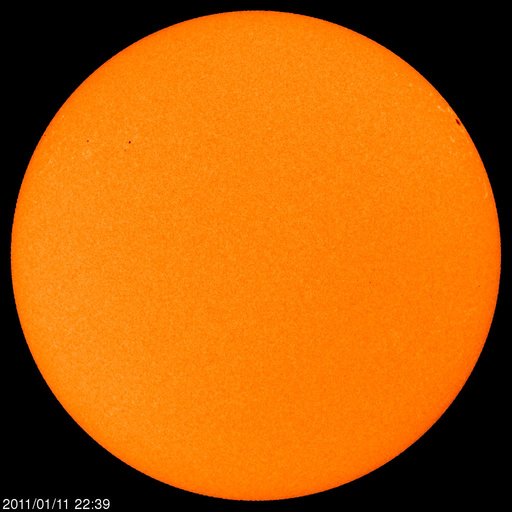
A spotless day looks like this:
The image, taken by the Solar and Heliospheric Observatory (SOHO) on Sept. 27, 2008, shows a solar disk completely unmarked by sunspots. For comparison, a SOHO image taken seven years earlier on Sept. 27, 2001, is peppered with colossal sunspots, all crackling with solar flares: image. The difference is the phase of the 11-year solar cycle. 2001 was a year of solar maximum, with lots of sunspots, solar flares and geomagnetic storms. 2008 is at the cycle's opposite extreme, solar minimum, a quiet time on the sun.
And it is a very quiet time. If solar activity continues as low as it has been, 2008 could rack up a whopping 290 spotless days by the end of December, making it a century-level year in terms of spotlessness.
Hathaway cautions that this development may sound more exciting than it actually is: "While the solar minimum of 2008 is shaping up to be the deepest of the Space Age, it is still unremarkable compared to the long and deep solar minima of the late 19th and early 20th centuries." Those earlier minima routinely racked up 200 to 300 spotless days per year.
Above: A histogram showing the blankest years of the last half-century. The vertical axis is a count of spotless days in each year. The bar for 2008, which was updated on Sept. 27th, is still growing. [Larger images: 50 years, 100 years]
Some solar physicists are welcoming the lull.
"This gives us a chance to study the sun without the complications of sunspots," says Dean Pesnell of the Goddard Space Flight Center. "Right now we have the best instrumentation in history looking at the sun. There is a whole fleet of spacecraft devoted to solar physics--SOHO, Hinode, ACE, STEREO and others. We're bound to learn new things during this long solar minimum."
As an example he offers helioseismology: "By monitoring the sun's vibrating surface, helioseismologists can probe the stellar interior in much the same way geologists use earthquakes to probe inside Earth. With sunspots out of the way, we gain a better view of the sun's subsurface winds and inner magnetic dynamo."
"There is also the matter of solar irradiance," adds Pesnell. "Researchers are now seeing the dimmest sun in their records. The change is small, just a fraction of a percent, but significant. Questions about effects on climate are natural if the sun continues to dim."
Pesnell is NASA's project scientist for the Solar Dynamics Observatory (SDO), a new spacecraft equipped to study both solar irradiance and helioseismic waves. Construction of SDO is complete, he says, and it has passed pre-launch vibration and thermal testing. "We are ready to launch! Solar minimum is a great time to go."
Coinciding with the string of blank suns is a 50-year record low in solar wind pressure, a recent discovery of the Ulysses spacecraft. (See the Science@NASA story Solar Wind Loses Pressure.) The pressure drop began years before the current minimum, so it is unclear how the two phenomena are connected, if at all. This is another mystery for SDO and the others.
Who knew the blank sun could be so interesting? More to come...
 
Walter
Avatar
#132
Dec 31, 2008
2008 Ends Spotless and with 266 Spotless Days, the #2 Least Active Year Since 1900, Portends Cooling
By Joseph D’Aleo CCM, AMS Fellow
2008 will be coming to a close with yet another spotless days according to the latest solar image.

This will bring the total number of sunspotless days this month to 28 and for the year to 266, clearly enough to make 2008, the second least active solar year since 1900.

See larger image here.
The total number of spotless days this solar minimum is now at around 510 days since the last maximum. The earliest the minimum of the sunspot cycles can be is July 2008, which would make the cycle length 12 years 3 months, longest since cycle 9 in 1848. If the sun stays quiet for a few more months we will rival the early 1800s, the Dalton Minimum which fits with the 213 year cycle which begin with the solar minimum in the late 1790s.

See larger image here.
Long cycles are cold and short ones like the ones in the 1980s and 1990s are warm as this analysis by -- in 1991 showed clearly.


See larger image --
In reply to the arguments made that the temperatures after 1990 no longer agreed with solar length, I point out that it was around 1990 when a major global station dropout (many rural) began which led to an exaggeration of the warming in the global temperature data bases. Also the length from max to max of 21 to 22 was 9.7 years and cycle 22 length min to min 9.8 years, both very short suggesting warm temperatures in the 1990s. The interval of cycle 22 max to cycle 23 max centered in the mid 1990s began to increase at 10.7 years and the min to min length of cycle 23 is now at least 12.3 years.
With the Wigley suggested lag of sun to temperatures of 5 years and Landscheidt suggested 8 years, a leveling off should have been favored around 2000-2003 and cooling should be showing up now. Looking ahead, put that together with the flip of the PDO in the Pacific to cold and you have alarming signals that this cooling of the last 7 years will continue and accelerate.
 
Walter
#133
Sun spot today! It's a cycle 23 though. This is very interesting.
 
darkbeaver
#134
Quote: Originally Posted by WalterView Post

Sun spot today! It's a cycle 23 though. This is very interesting.

Have you got a link Walter?
 
Walter
#135
Quote: Originally Posted by darkbeaverView Post

Have you got a link Walter?

--
 
Walter
Avatar
#136
Wow, if true.

--

1 08 2009
Leif Svalgaard writes:
Some speculation that solar cycle 25 has already begun:
--
From a 2006 NASA News article - In red, David Hathaway's predictions for the next two solar cycles and, in pink, Mausumi Dikpati's prediction for cycle 24, and the expected "low" cycle 25.

Graph source: NASA News
This would be stunning, because it suggests that the sun has skipped a solar cycle (#24) . Researchers, three from the Harvard-Smithsonian Center for Astrophysics and the other from Marshall Space Flight Center-NASA, have published a paper that suggests this possibility.
Does a polar coronal hole’s flux emergence follow a Hale-like law?
A. Savcheva1, J.W. Cirtain2, E.E. DeLuca1, L. Golub1

ABSTRACT
Recent increases in spatial and temporal resolution for solar telescopes sensitive to EUV and X-ray radiation have revealed the prevalence of transient jet events in polar coronal holes. Using data collected by the X-Ray Telescope on Hinode, Savcheva et al. (2007) confirmed the observation, made first by the Soft X-ray Telescope on Yohkoh, that some jets exhibit a motion transverse to the jet outflow direction.
The velocity of this transverse motion is, on average, 20 kms−1. The direction of the transverse motion, in combination with the standard reconnection model for jet production (e.g. Shibata et al. 1992), reflects the magnetic polarity orientation of the ephemeral active region at the base of the jet. From this signature, we find that during the present minimum phase of the solar cycle the jet-base ephemeral active regions in the polar coronal holes had a preferred east-west direction, and that this direction reversed during the cycle’s progression through minimum.
In late 2006 and early 2007, the preferred direction was that of the active regions of the coming sunspot cycle (Cycle 24), but in late 2008 and early 2009 the preferred direction has been that of the active regions of sunspot cycle 25. These findings are consistent with the results of Wilson et al. (198 that there is a high latitude expansion of the solar activity
cycle.
Full paper here:
--
 
Walter
#137
48 days without a sunspot; no wonder it's cold.
 
Walter
Avatar
#138
50 Days Blank
08/29/2009 by Kevin VE3EN at 22:45


The sun has been blank of official sunspots for 50 days in a row. This is only the 4th time the sun has been blank for atleast 50 days since 1849. The 3rd longest streak on the list is 54 days between February-April 1879. The record is 92 days in 1913. We still have a while to go before we beat the record. Click the link below for all of the spotless day streak records. --

From: --
 
Tonington
Avatar
#139
Quote: Originally Posted by WalterView Post

48 days without a sunspot; no wonder it's cold.

Yup, pretty darned cold... Since Walter loves the day to day weather as an indicator... I'll go one better and give him monthly data, and back-to-back. This must mean the oceans will be boiling in the tropics very soon, according to the trends!

Ocean temperatures:

Warmest June on record
Warmest July on record

And all that with nary a Sunspot in sight. Hmmmm.
 
Walter
Avatar
#140
December 08, 2009
--

Why should we worry about the lack of sun spots and declining Ap Index? The lack of sunspots has been associated with long periods of extreme cold on this planet. This cold had major impacts on agriculture and the ability of humans to feed large populations.

There seem to be an connection between sunspots and cloud cover. Less cloud cover and more of the sun's radiation reaches the earth. The more cloud cover the more that radiation is reflected back into space. A presentation by Jasper Kirkby, CLOUD Spokesperson, CERN, shows what we currently know about the correlations between Cosmic Rays and variations in the climate.

The -- experiment uses a cloud chamber to study the possible link between galactic cosmic rays and cloud formation. Kirkby talks about the results from the first CLOUD experiment and the new CLOUD experiment and what it will deliver on the intrinsic connection between Cosmic Rays and cloud formation.
Kirkby's one hour presentation is hosted at Seeking Alpha. Get your coffee, coke or cocktail, or what ever helps you think and learn about the cosmic ray and cloud connection. --.
 
eanassir
#141
The sun and the cloud formation and dispersion

My personal observation, which is not related to the Quran and its interpretation.
This observation may be correct or wrong.

I confirm there is some correlation between the sun heat and the cloud collection and dispersion.

Most of the cloud formation and rain is at night, and relatively less at day time. This is in the temperate or hot countries like Iraq.

Frequently when there are clouds and the sky is cloudy at day time; then almost at noon time when the sun rays are about perpendicular to the ground, the clouds will disperse and relatively the cloud will become more thin and mostly the sky will appear from through the pieces of the dispersed clouds.

Therefore, it may be the sun heat has an effect on dispersing and thinning the cloud, and when the sun rays are weak and oblique to the ground then more cloud will collect and become thicker.

What do you think?
 
eanassir
#142
Moreover, it is obvious the fog will start to disappear when the sun rises and will almost disappear completely, withins few minutes or more, as the sun heat becomes more in the progress of the day.

And while the fog is some sort of precipitation like the cloud; so it is evident that the sun has direct influence on the cloud formation and dispersion.

Therefore, certainly when sun spots appear and there is disturbance in the heat and sun rays reaching the earth; so surely the effect of the sun rays on the climate and cloud formation and dispersion on the earth is evident; is this related to the subject or not?
 
AnnaG
Avatar
#143
Sunspots:

--

Fog:

--

Fog is just plain obvious to anyone with an inkling of and idea about climatology, meteorology, or just plain sense.

Watch a video clip filmed in IR of a pot of water coming to a boil sometime.
 

Similar Threads

3
The Mystery of Consciousness
by Curiosity | Jan 26th, 2007
3
The mystery of the eye
by jjw1965 | Oct 31st, 2005
no new posts