


Royal Marines unveil stealth boat as latest weapon in war on terror
2nd July 2007
Daily Mail

This new secret superboat is the latest British weapon to help fight the war on terror.
The stealth boat, to be used by the Royal Marines, is thought to be capable of reaching speeds of about 70mph.
The vessel will be used in various roles including the insertion of troops in enemy territory and the hunting of drugs smugglers.
It is believed to have been designed and built by VT Halmatic, based in Portsmouth, Hampshire, as a replacement for two boats currently used by the elite SBS.
Experts believe the dull-grey boat will have been designed using stealth technology to help it avoid radar detection.
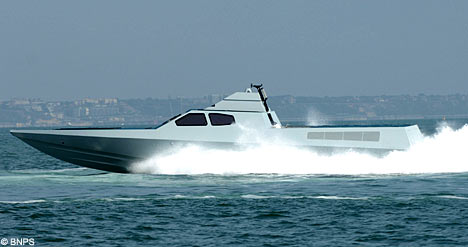
The new stealth superboat is believed to be capable of reaching 70mph - which, on the water, is terrifyingly fast
One of the boats has been spotted being put through its paces off the coast in Poole, Dorset, where the SBS is based.
It will then be rolled out for service around the world.
With special services on operations in numerous theatres of war around the world, the new craft will see plenty of action.
They will be used to insert and extract troops, patrol dangerous waters and hunt down drug smugglers in the Caribbean.
The new boats are thought to be replacing the VSV - very slim vessel - and a more traditional-looking interceptor craft that have been in service for some years.
An anonymous source said: "The thing certainly has a menacing style and is incredibly quick and quite quiet.
"I daresay it is extremely versatile and can be adapted so it can be employed in a number of roles.
"Apparently it is a replacement for two boats that are used by the SBS at the moment, but of course will have to undergo very tough trials.
"Other boats used by the special services have angled designs to help avoid detection by radar and they are coated in radar-absorbent materials.
"The hulls are designed to produce a small wake and with a top speed of anything up to 60 knots they are formidable craft - and this is the newest design.
"Nobody knows too much because there has been a lot of secrecy about them, but they are British built and have been spotted in Poole going very quickly."
dailymail.co.uk
2nd July 2007
Daily Mail
This new secret superboat is the latest British weapon to help fight the war on terror.
The stealth boat, to be used by the Royal Marines, is thought to be capable of reaching speeds of about 70mph.
The vessel will be used in various roles including the insertion of troops in enemy territory and the hunting of drugs smugglers.
It is believed to have been designed and built by VT Halmatic, based in Portsmouth, Hampshire, as a replacement for two boats currently used by the elite SBS.
Experts believe the dull-grey boat will have been designed using stealth technology to help it avoid radar detection.
The new stealth superboat is believed to be capable of reaching 70mph - which, on the water, is terrifyingly fast
One of the boats has been spotted being put through its paces off the coast in Poole, Dorset, where the SBS is based.
It will then be rolled out for service around the world.
With special services on operations in numerous theatres of war around the world, the new craft will see plenty of action.
They will be used to insert and extract troops, patrol dangerous waters and hunt down drug smugglers in the Caribbean.
The new boats are thought to be replacing the VSV - very slim vessel - and a more traditional-looking interceptor craft that have been in service for some years.
An anonymous source said: "The thing certainly has a menacing style and is incredibly quick and quite quiet.
"I daresay it is extremely versatile and can be adapted so it can be employed in a number of roles.
"Apparently it is a replacement for two boats that are used by the SBS at the moment, but of course will have to undergo very tough trials.
"Other boats used by the special services have angled designs to help avoid detection by radar and they are coated in radar-absorbent materials.
"The hulls are designed to produce a small wake and with a top speed of anything up to 60 knots they are formidable craft - and this is the newest design.
"Nobody knows too much because there has been a lot of secrecy about them, but they are British built and have been spotted in Poole going very quickly."
dailymail.co.uk

