Misleading analyses on Canada's supposedly poor economic performance should be ignored
Alex Ovechkin led the NHL in goals last season, with 53. But in the 1992-93 season, scoring 53 goals would have only been good for a 3-way tie for 11th place in goal scoring.
Should we dismiss Ovechkin's 2014-15 season as not a valuable contribution to his team's offense, since his 53 goals would have landed him no higher than 11th in the scoring race in 1992-93?
Of course not. Such a comparison makes no sense: in 1992-93, teams scored on average 3.63 goals per game. By contrast, the highest scoring team last year in the NHL was the Tampa Bay Lightning, which scored 3.16 goals per game.
Just as comparing Ovechkin's goal total from 2014-15 to the number of goals players scored in the 1992-93 season makes no sense, saying that Canada's economic performance under the Conservatives has been the worst among the last nine federal governments (as is the claim
put forward by Unifor in a report released over the summer) is not a useful comparison.
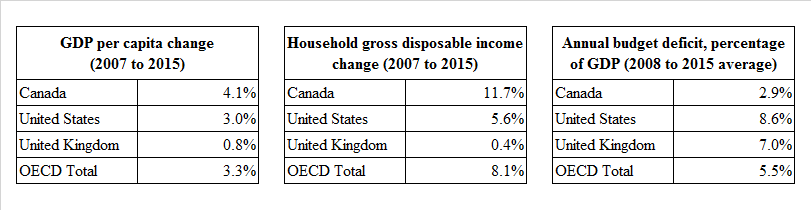
A more useful analysis would be one that compares Canada's recent economic performance to other developed countries over the same time period. The numbers show that in recent years, Canada has experienced better economic growth, enjoyed greater increases in household gross disposable income (after-tax income), and ran lower budget deficits.
Misleading analyses on Canada's supposedly poor economic performance should be ignored
you're welcome again.



 Lorrie Goldstein Verified account @sunlorrie