


Parishioners had to wait for their new toilet after skeletons dating from as far back as the Anglo-Saxon era were unexpectedly found at a church.
Some 40 graves lay just 18in below a path outside Holy Trinity Church in Hildersham, Cambridgeshire.
Archaeologists examined 19 intact skeletons from the 9th or 10th Century, predating the church by several hundred years, but left 24 graves intact.
The toilet has now been completed and the skeletons laid in a new grave.
Hildersham church loo flushes out ancient skeletons
BBC News
10 April 2016
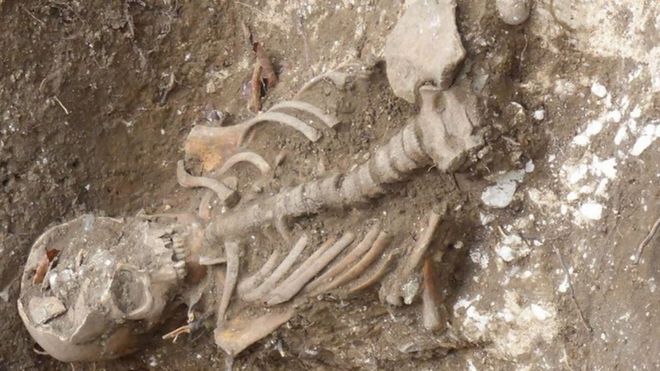
Skeletons were found just inches below the surface outside the church door
Parishioners had to wait for their new toilet after skeletons dating from as far back as the Anglo-Saxon era were unexpectedly found at a church.
Some 40 graves lay just 18in below a path outside Holy Trinity Church in Hildersham, Cambridgeshire.
Archaeologists examined 19 intact skeletons from the 9th or 10th Century, predating the church by several hundred years, but left 24 graves intact.
The toilet has now been completed and the skeletons laid in a new grave.
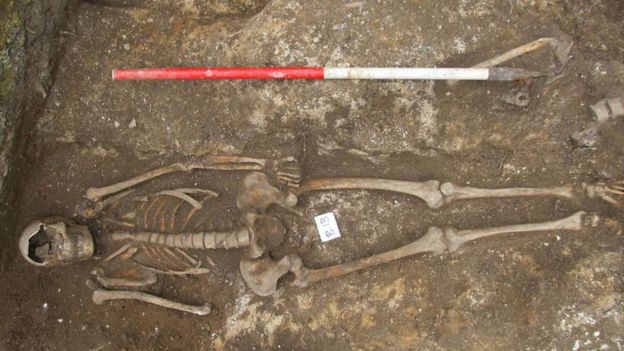
Archaeologists examined 19 intact skeletons at the site last year
Holy Trinity churchwarden and local historian Andrew Westwood-Bate said they expected to "discover some bones while digging but this was completely unexpected".
"The Victorians did a lot of work here and there are underground pipes brushing past the graves, but amazingly nothing had disturbed them," he said.
'Most moving moment'
He believes the skeletons are Anglo-Saxon, although Cambridge University Archaeological Unit experts who examined the site said it was not possible to be precise as bones from consecrated ground could only be removed from the land in "exceptional circumstances".
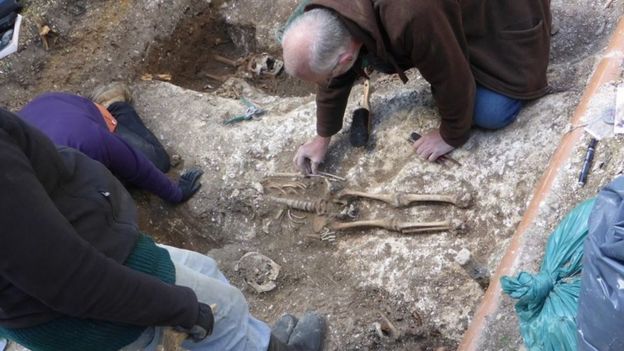
The bodies of several children were found during the excavation

Surgeon and sculptor Per Hall, who lives in the village, made a mould of the grave of one of the children
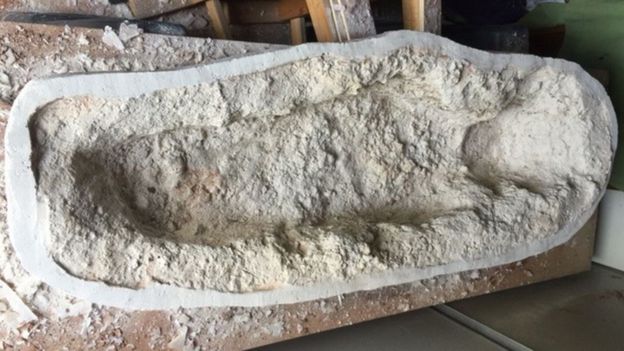
The finished article will be a permanent memorial to those who died
They dated the burials "broadly" to the 11th or 12th Century. Five of the skeletons were children.
Mr Westwood-Bate said that that discovery was "one of the most moving moments" of the excavation.
The graves were dug into the chalk and bodies laid directly in the cavity. A mould of the grave of one child has been made as a memorial to previous "parishioners" of Hildersham.
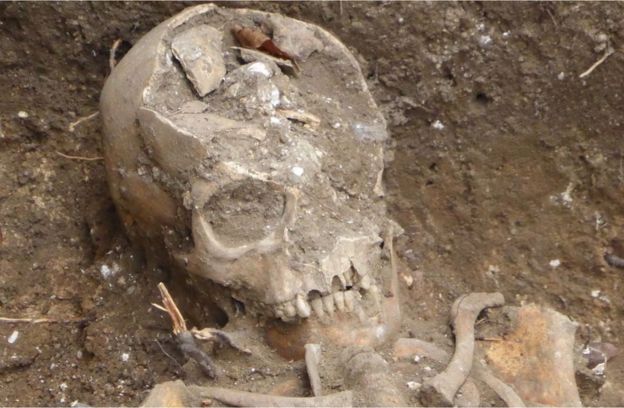
The graves are thought to be those of villagers who lived near what was probably a former church on the present site
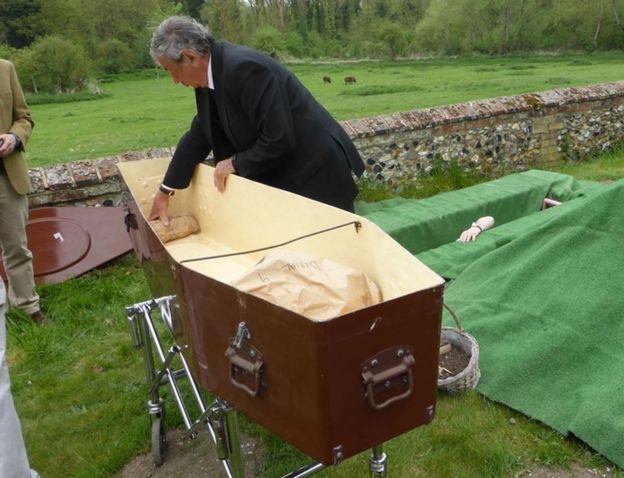
The skeletons were laid to rest together and a funeral was held before they were reburied
It is thought the graves belong to villagers who lived outside the walls of what was probably an Anglo-Saxon church.
The exhumation was carried out with "great reverence" and "as little public knowledge as possible", Mr Westwood-Bate said.
Each night the bones were stored in the mortuary at the village undertaker's.

The exhumed skeletons have been buried together in a grave overlooking what would have been their village more than 1,000 years ago
A "proper funeral" was conducted as the skeletons were laid to rest in one coffin. A headstone will be added later.
They were interred near the churchyard wall "out in the sunshine looking over the field where they would have lived", Mr Westwood-Bate said.
"So they've gone back home."

Andrew Westwood-Bate shows off the toilet that led to the discovery of the churchyard skeletons

Holy Trinity Church in Hildersham, Cambridgeshire
Hildersham church loo flushes out ancient skeletons - BBC News
Some 40 graves lay just 18in below a path outside Holy Trinity Church in Hildersham, Cambridgeshire.
Archaeologists examined 19 intact skeletons from the 9th or 10th Century, predating the church by several hundred years, but left 24 graves intact.
The toilet has now been completed and the skeletons laid in a new grave.
Hildersham church loo flushes out ancient skeletons
BBC News
10 April 2016
Skeletons were found just inches below the surface outside the church door
Parishioners had to wait for their new toilet after skeletons dating from as far back as the Anglo-Saxon era were unexpectedly found at a church.
Some 40 graves lay just 18in below a path outside Holy Trinity Church in Hildersham, Cambridgeshire.
Archaeologists examined 19 intact skeletons from the 9th or 10th Century, predating the church by several hundred years, but left 24 graves intact.
The toilet has now been completed and the skeletons laid in a new grave.
Archaeologists examined 19 intact skeletons at the site last year
Holy Trinity churchwarden and local historian Andrew Westwood-Bate said they expected to "discover some bones while digging but this was completely unexpected".
"The Victorians did a lot of work here and there are underground pipes brushing past the graves, but amazingly nothing had disturbed them," he said.
'Most moving moment'
He believes the skeletons are Anglo-Saxon, although Cambridge University Archaeological Unit experts who examined the site said it was not possible to be precise as bones from consecrated ground could only be removed from the land in "exceptional circumstances".
The bodies of several children were found during the excavation
Surgeon and sculptor Per Hall, who lives in the village, made a mould of the grave of one of the children
The finished article will be a permanent memorial to those who died
They dated the burials "broadly" to the 11th or 12th Century. Five of the skeletons were children.
Mr Westwood-Bate said that that discovery was "one of the most moving moments" of the excavation.
The graves were dug into the chalk and bodies laid directly in the cavity. A mould of the grave of one child has been made as a memorial to previous "parishioners" of Hildersham.
The graves are thought to be those of villagers who lived near what was probably a former church on the present site
The skeletons were laid to rest together and a funeral was held before they were reburied
It is thought the graves belong to villagers who lived outside the walls of what was probably an Anglo-Saxon church.
The exhumation was carried out with "great reverence" and "as little public knowledge as possible", Mr Westwood-Bate said.
Each night the bones were stored in the mortuary at the village undertaker's.
The exhumed skeletons have been buried together in a grave overlooking what would have been their village more than 1,000 years ago
A "proper funeral" was conducted as the skeletons were laid to rest in one coffin. A headstone will be added later.
They were interred near the churchyard wall "out in the sunshine looking over the field where they would have lived", Mr Westwood-Bate said.
"So they've gone back home."
Andrew Westwood-Bate shows off the toilet that led to the discovery of the churchyard skeletons
Holy Trinity Church in Hildersham, Cambridgeshire
Hildersham church loo flushes out ancient skeletons - BBC News