The Tarriff Hype.

Ron in Regina

"Voice of the West" Party
Apr 9, 2008
33,378
11,973
113
Regina, Saskatchewan
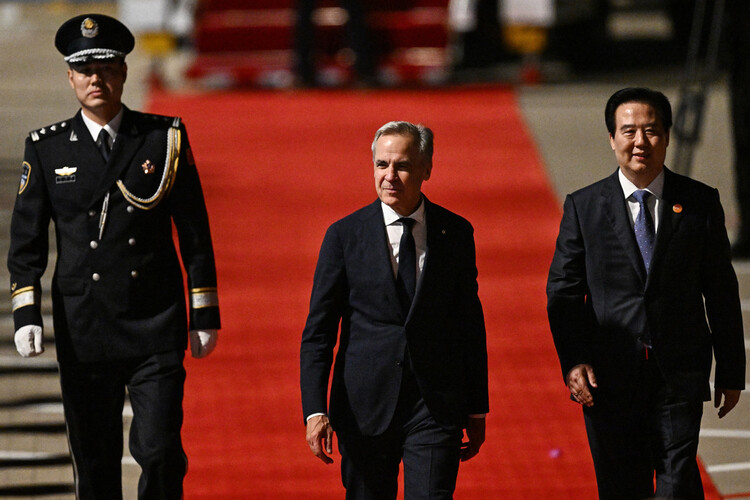
Prime Minister Mark Carney’s office made the announcement Tuesday morning after he met with Chinese President Xi Jinping on the sidelines of the Asia-Pacific Economic Cooperation (APEC) summit in Shenzhen, China.

Chinese governments continued their rapprochement Tuesday, with China agreeing to provide tariff relief on roughly $400-million of Canadian pork, fish and seafood while Canada opened the door to more Chinese steel and aluminium.

According to the federal government, China agreed to extend until 2028 an agreement that provided tariff relief on imports of Canadian frozen pork cuts as well as certain fish and seafood products such as frozen cold-water shrimp and prawns, molluscs and Greenland halibut. The deal — first signed when Carney visited China in January — was set to expire at the end of the year.

In exchange, Canada agreed to extend and expand its tariff remission program on certain Chinese steel and aluminium products until 2028. The Canadian release says that new Chinese products covered by the remissions are “items for which Canadian supply is insufficient or unavailable.”
Ahead of the meeting, a key advisor to American President Donald Trump and frequent critic of Canada warned that a closer relationship between Carney and Xi could be seen as a step away from the U.S.

“Are u really threatening to play China off the U.S.? This is offensive in the extreme. You should be far more worried China is going to eat Canada alive — as it is already doing,” Peter Navarro wrote on X on Monday.

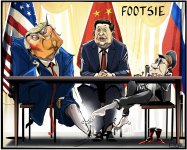
Donald Trump suffered the biggest midterm loss in fifty years, you may recall that the president of the United States called Canada “one of the worst countries in the entire world.” He said, basically, that he prefers the Chinese to us, despite the industrial (and other kinds of) espionage and their strategic partnership with Iran and “great power competition” and the fact that he blames them for the pandemic—and so on and so forth, and this would be the honeymoon phase of the bilateral negotiations on trade🙄.
 

Ron in Regina

"Voice of the West" Party
Apr 9, 2008
33,378
11,973
113
Regina, Saskatchewan

petros

The Central Scrutinizer
Nov 21, 2008
121,460
15,174
113
Low Earth Orbit
Lots to unpack here:
No shit. 2 desperate Superpowers grovelling with the new Super Duperpower Chief. This will be interesting
 

spaminator

Hall of Fame Member
Oct 26, 2009
41,155
4,190
113
Hollywood's plan to take back Hollywood North should have Canada worried
New U.S. tax credits could lure productions, visual effects work and television series away from Canada.

Author of the article:Brian Lilley
Published Nov 18, 2026 • Last updated 12 hours ago • 4 minute read

The historic Hollywood sign is viewed on October 07, 2021 in Los Angeles, California. New U.S. tax credits could lure productions, visual effects work and television series away from Canada. Photo by Mario Tama /Getty Images

Hollywood wants its productions back and they’re coming for Hollywood North. What should worry Canada’s film industry is that the push to Make Hollywood Great Again has the support of Democrats, Republicans and President Donald Trump.


Unlike Trump’s idle threat to put 100% tariffs on Hollywood movies or shows filmed in Canada, Britain or Australia, House Resolution 10582 has the ability to hit Canadian productions hard.

Most American film and TV production in Canada is centred in Vancouver and Toronto, while visual effects work is concentrated in Vancouver and Montreal.

Each year, billions of dollars’ worth of productions head north, creating tens of thousands of jobs and keeping domestic production viable. Canada has the talent pool we do in this industry because of the combination of domestic and foreign production. Made-in-Canada productions can’t sustain the size of the industry we have now.

Many of these productions are lured here in part due to factors like the weak Canadian dollar, but also generous federal and provincial tax credits.


A production shooting in Toronto can take advantage of a 16% federal tax credit against qualified Canadian labour expenditures and a 21.5% provincial credit for qualifying production expenditures such as goods, services and labour incurred in Ontario.

British Columbia has a more generous credit of 36%, while Quebec’s is up to 25% of admissible expenses. Those three provinces account for about 90% of foreign productions in recent years and they stand to lose billions in economic activity if the bill currently before the House of Representatives becomes law.

Washington wants the cameras back
The proposal already has bipartisan support and, recently, Trump came out in favour of it with a post to his Truth Social account.

“It can be done quickly, accurately, efficiently and, importantly, will benefit all of America. MAKE OUR ENTERTAINMENT INDUSTRY GREAT AGAIN!” Trump wrote.

What the bill would do, if passed, is establish a federal production tax credit that would be much more generous toward studios than anything on offer in Canada.


Major production states already offer generous tax credits of between 20-40%, but there has never been a federal credit.

This bill would offer a 20% federal credit that could rise to 30% through various bonuses.

It also applies to the salaries of the stars appearing in the movie.

Canada’s federal credit only applies to Canadian labour costs and there is a residency test. So bringing a star actor or director making $10 million up to Canada might save you some money on the wages of the grip and best boy, but not the star.

If this bill passes, that federal tax credit would apply to the star’s salary as long as at least 75% of the shooting was done in the United States. It’s tough for a studio to look past a $2-3 million tax credit on that star’s salary.

TV productions in the crosshairs
H.R. 10582 has to be especially worrisome for the television production industry in Canada. Shooting American TV shows is the bread and butter of this industry and the Americans want them back.


The bill is backed by Republicans and Democrats in both the House and Senate.

“The support and popularity of doing this, and bringing Entertainment back to the United States of America, has been unbelievable! Hollywood, and so many other places, have been virtually “emptied out” by the Tax Incentives, and much more, given by other Countries,” Trump posted.

The bill is supported by the Motion Picture Association, the Directors Guild and Screen Actors Guild, along with unions representing crews such as Teamsters, LiUNA and IATSE, all of which also represent crew workers here in Canada.


Canada has few options
The Motion Picture Association estimates that with the tax credit in place, the American share of Hollywood’s TV production would rise from 42% to 65%. Canada, where our cities regularly double for New York, Chicago and Seattle, is the easiest place to take that production from.


If we saw most of that 23-point shift in TV production hit Canada, the impact would be north of $1.5 billion in economic activity and more than 20,000 jobs lost.

The tough part is that there is no way to fight this other than offering more generous credits. We’ve been luring these productions north for decades with tax breaks; we can’t very well complain if the Americans lure them back with more of the same.

The good news for us, for now, is that the bill has not passed.

Even if it passes, productions are planned well in advance and major U.S. centres lack the capacity to absorb all this production overnight.

We’ve spent decades enticing Hollywood north with tax breaks and subsidies. If Washington starts offering bigger cheques, we shouldn’t be surprised when Hollywood heads home.
 

Ron in Regina

"Voice of the West" Party
Apr 9, 2008
33,378
11,973
113
Regina, Saskatchewan
Whether Lutnick will lose his job is unclear? Asked Monday whether he planned to fire the commerce secretary, Trump defended him. “No, he’s done a very good job,” the president said. A Republican-controlled Senate could give Trump an incentive to nominate any replacement before January, when confirmation could become more difficult under Democratic control?

Sen. Jim Banks, R-Ind., a member of the Senate Banking Committee, told Fox News Sunday that he wants to question Lutnick. “Howard Lutnick has legally transferred his private business interests to his very young sons, but it has been reported that he has not been diligent in making chip companies accountable, which raises questions about how his family’s business has benefited from his public office,” said Andrew Hale, fellow at Advancing American Freedom in Washington.

Yet according to The New York Times, Trump was first briefed on intelligence involving then-Nvidia CEO Jensen Huang and a woman suspected of spying for China (identified in reports as Alice Huang) around October 2025. Disclosures show Trump’s accounts bought Nvidia shares the day after announcing he would allow H200 chip sales to China in December 2025, and executed 38 Nvidia trades—including purchases—during the first eight months of 2026.

Reporting indicates Rubio briefed Trump in May 2026 ahead of a China trip. Disclosures show a sale of $500,001 to $1 million on May 18, 2026, alongside smaller purchases of $15,001 to $50,000 on May 15 and $100,001 to $250,000 on May 21. A financial disclosure released in October 2026 showed that in August 2026 alone, Trump’s accounts bought up to $1.6 million in Nvidia stock and sold up to $1 million. Trump has stated he has not heard from Rubio that the woman was a spy and questioned whether she actually is one.🤔

Lutnick faces scrutiny over allegations that he resisted restrictions intended to prevent Nvidia’s advanced chips from reaching China, despite warnings involving the company’s CEO and an alleged Chinese spy. He also faces questions about potential conflicts of interest involving his family’s financial firm. Naturally, Americans are concerned about this even if the current administration isn’t.

The American electorate delivered congressional control to the Democrats, who want to ease U.S. tariffs on Canada. Meanwhile, the Nvidia fallout has Commerce Secretary Howard Lutnick — a major proponent of Donald Trump’s tariffs, particularly those on autos, steel, and aluminum — facing increased pressure.

As commerce secretary, Lutnick oversees negotiations over the Section 232 tariffs on steel, aluminum and autos that Ottawa wants eliminated or significantly reduced. That makes him important to the talks while he remains in office. Lutnick’s refusal to budge on tariffs was reportedly a major contributor to the collapse in Canada-U.S. talks in August. Lutnick will probably face questions about the as-yet non-public investigations that led to the 232 tariffs and Nvidia matters.
Canadian Prime Minister Mark Carney is feeling pretty good about the progress of tariff talks—with China. He just brokered another trade deal with China that covers around $400 million in exports and eases duties on Chinese steel and aluminum. Carney is pursuing closer ties with Europe and will soon sign a new deal with India, giving Canada free-trade access to around 3 billion consumers worldwide.

But negotiations with the U.S., its largest trading partner, remain acrimonious and unpredictable. Canada and Mexico reaffirmed their commitment to renewing the United States-Mexico-Canada Agreement (USMCA), which covers $2 trillion in annual trade, putting pressure on Trump to do the same.

Negotiating with China is an even more delicate dance. While Xi greeted Trump at the airport, a first, the Chinese leader is also locked in a fierce competition over everything from rare earths to advanced chips. The latter took a darker turn with the ouster of Nvidia CEO Jensen Huang following revelations that he had an affair with an alleged Chinese spy. Xi’s speech on “free and open trade” and critique of unilateralism and protectionism was clearly meant to position China as a reasonable and productive partner. And America’s trading partners are listening.