It's Climate Change I tell'ya!! IT'S CLIMATE CHANGE!!

Ron in Regina

"Voice of the West" Party
Apr 9, 2008
33,262
11,929
113
Regina, Saskatchewan
The unexplained death this month of a Russian lab technician at a Siberian facility for the study of dangerous pathogens raised global anxieties over the potential for an outbreak of pneumonic plague.

But while the cause of concern – bound up in a lack of transparency from Moscow – was new, Russia’s frozen hinterlands have long been the source of a separate fear that they could harbor disease risks for which the world is not prepared.
So this is another Wuhan wet market thing?
 

spaminator

Hall of Fame Member
Oct 26, 2009
41,032
4,154
113
Russia’s frozen hinterlands long been feared to harbour disease risks
Russian authorities imposed containment measures after the 28-year-old’s death from what they said was pneumonia of “unknown origins.”

Author of the article:Washington Post
Published Oct 17, 2026 • 3 minute read
Permafrost melts into the Kolyma River outside of Zyryanka, Russia, in July 2019.
Permafrost melts into the Kolyma River outside of Zyryanka, Russia, in July 2019. Photo by Michael Robinson Chavez /The Washington Post
Mary Ilyushina


The Washington Post


The unexplained death this month of a Russian lab technician at a Siberian facility for the study of dangerous pathogens raised global anxieties over the potential for an outbreak of pneumonic plague.

But while the cause of concern – bound up in a lack of transparency from Moscow – was new, Russia’s frozen hinterlands have long been the source of a separate fear that they could harbor disease risks for which the world is not prepared.

Russian authorities imposed containment measures after the 28-year-old’s death from what they said was pneumonia of “unknown origins,” prompting the United States to ask for more information. A World Health Organization report released Saturday said that Russian authorities found no signs of an outbreak of plague or some other infectious disease, but did not provide sufficient details to identify the origin of the woman’s illness or say whether exposure at work played a role in it.

Siberia’s vast wilderness harbors natural reservoirs of pathogens, from fleas that spread plague found in marmots and squirrels to ticks bearing encephalitis to the ancient pathogens frozen in the layer of permafrost.


The Russian institute where the lab technician worked was set up in the 1930s as a plague prevention station to curb outbreaks of the deadly bacterial disease that periodically affected local populations as well as people in neighboring Mongolia and China’s Manchuria region. The disease, for which early antibiotic treatments were pioneered that decade, could be spread through contact with marmots, which were hunted for meat and sometimes eaten undercooked or even raw, like in a 2019 case of a Mongolian couple.

The settlement of Siberia, which had a 19th-century gold rush and served as a place of exile for criminals under the Russian Empire, connected the remote region to the western parts of the empire and raised the risk of plague spreading farther west, much as epidemic diseases from European Russia, such as cholera and typhus, easily reached Siberia through migrating workers and because of the near-total absence of medical care.

A study published this year suggested that the bands of hunter-gatherers who inhabited the Lake Baikal region were the victims of the earliest known plague outbreak, about 5,500 years ago. To this day, plague remains endemic in parts of Siberia and the Russian Far East, where the bacterium persists naturally among wild rodents.


Human cases in Russia are rare, however. The country’s last recorded human infection was in 2016, when a 10-year-old boy in the Altai region contracted plague after contact with a marmot.

The threat of dangerous disease comes not only from wildlife but also from the millennia-old microbes and viruses stored in the permafrost that underlies the vast majority of the region.

About a decade ago, a group of researchers isolated “zombie viruses” from Siberian permafrost, raising fears that a new global medical emergency could be triggered by a disease from the distant past.

The permafrost, a dark, cold, oxygenless mass, is a perfect storage container for biological material, and scientists believe that at its deepest levels it may contain viruses up to a million years old, far older than Homo sapiens, the modern human species.

In 2023, the researchers – led by Jean-Michel Claverie of Aix-Marseille University in France – published a landmark study in the journal Viruses documenting the revival of ancient viruses from the Siberian permafrost.


The report warned that accelerating permafrost thaw caused by climate change poses a potential public health threat by releasing dormant pathogens. Claverie’s team isolated 13 ancient viruses taken from locations across Siberia, belonging to five new viral groups. The oldest, a Pandoravirus yedoma, had been frozen solid beneath an underground lake for 48,500 years, while other, younger strains (around 27,000 years old) were extracted from the remains of a woolly mammoth’s stomach and from mammoth wool.

Other researchers have noted that although the revived viruses were able to infect amoebas in lab conditions, it is unclear whether such viruses could infect animals or humans, or find a host outside a controlled laboratory.

Claverie and his team cautioned at the time that unknowns remain buried in the permafrost, and a warming climate, which would also open previously untouched lands to deeper development, could expose people to pathogens that affect humans.

In 2016, climate change played a role in unleashing anthrax in the remote Yamalo-Nenets region of Siberia, experts said at the time. Unusually high temperatures that summer, soaring to 95 degrees Fahrenheit, melted permafrost, and according to one hypothesis, exposed an infected reindeer carcass. The pathogen spread to living reindeer and eventually to a community of nomadic herders, where a 12-year-old boy died.
lets hope russia experiences more climate change. ;) :cool:
 
  • Like
Reactions: Taxslave2

spaminator

Hall of Fame Member
Oct 26, 2009
41,032
4,154
113
Australian lawmaker loses both legs after 'targeted' attack
He did not speak in court or apply for bail and his next hearing is scheduled for February 4.

Author of the article:AFP
AFP
Published Oct 21, 2026 • 3 minute read
Australian politician Helen Haines (C) is in a critical but stable condition in a Melbourne hospital after being struck by a car on Monday near her office in the town of Wangaratta.
Australian politician Helen Haines (C) is in a critical but stable condition in a Melbourne hospital after being struck by a car on Monday near her office in the town of Wangaratta. Photo by William WEST /AFP

Melbourne, Oct 21, 2026 (AFP) — Australian lawmaker Helen Haines has had both legs amputated after being hit by a car, her husband said on Wednesday, hailing her as a “fighter” despite critical injuries sustained in what police described as a targeted attack.


Haines is now in a stable condition at a Melbourne hospital days after being struck by a car on Monday near her office in the town of Wangaratta, just over 200 kilometres (120 miles) northeast of the Victoria state capital.

The incident has prompted soul-searching in a country where political violence is rare but where police have documented a steady rise in threats and abuse towards elected officials in recent years.

Prime Minister Anthony Albanese has led tributes to Haines, an independent member of parliament and a passionate campaigner for transparency and against corruption.

And he has acknowledged the need for Australians to turn down the temperature and embrace respectful disagreement over polarisation.


Speaking at the hospital on Wednesday, Haines’s husband of almost 40 years, Phil, said that after days in intensive care, surgeons had been forced to amputate both her legs.

“But the good news in all this is Helen is alive and she’s stable. That is the most important thing for our family,” he said.

“The two most important parts of Helen for us as a family are her heart and her mind.

“Her heart is huge. She is a very compassionate, caring, loving person.

“Helen’s road to recovery will be long and difficult, but we know she is a fighter.”

People lay flowers outside the office of Australian politician Helen Haines in the northern regional city of Wangaratta, some 250 kilometres north-east of Melbourne on October 20, 2026. Australian independent lawmaker Helen Haines underwent surgery overnight but remains in a critical condition after being struck deliberately by a car in an attack, Prime Minister Anthony Albanese said on October 20. (William WEST/AFP)
– ‘Extremist views’ –
The man alleged to have wounded Haines in what police have called a “targeted” attack faced court for the first time earlier on Wednesday.

Forty-three-year-old Brendan Nugent has been charged with dangerous driving causing serious injury and intentionally causing serious injury, as well as the federal crime of harming a public official, which carries a maximum penalty of 10 years in prison.

He has also been charged with cultivating a cannabis plant and possession of the drug, according to court documents shared with AFP.


Nugent appeared at a courthouse in Wangaratta, an AFP journalist at the scene said.

He did not speak in court or apply for bail and his next hearing is scheduled for February 4.

Governor-General Sam Mostyn — King Charles III’s official representative in Australia — said the nation was crying out for “decency”.

“Australians are yearning for kindness and care, and they’re asking us why we’ve lost the great skill of disagreeing well,” Mostyn said alongside Phil Haines.

The motive remains unknown and authorities will not speculate while the investigation is ongoing.

But police said Wednesday they were examining all possible leads, including that Nugent may have held radical anti-government views.

“We’re examining social media associations, talking to witnesses, friends and colleagues,” Victoria police commissioner Mike Bush told journalists.

Bush said authorities held no intelligence on the suspect and had seen nothing to suggest he posed an immediate threat.


Australian Federal Police Commissioner Krissy Barrett pointed to a growing and concerning level of “extremist views” online.

She said the incident was “what many had been dreading for some time”.


– World ‘more dangerous’ –
Helen Haines entered parliament in 2019 after working as a nurse and midwife, becoming known for stances such as supporting stronger climate action.

The independent lawmaker, 65, was standing near the trunk of her car when she was struck by a Toyota Land Cruiser on Monday afternoon.

Witnesses told national broadcaster ABC they saw her pinned between the two vehicles.

Threats against Australian lawmakers and electorate offices doubled between 2021 and 2025, with 1,067 incidents reported to police last year.

Highlighting the tense climate, police in Western Australia charged a man late on Wednesday after he made threats and swung nunchucks at the office of state lawmaker Hannah Beazley, media said.

The incident has drawn comparisons to other acts of violence against elected officials elsewhere, most notably the killing of British lawmaker Jo Cox outside her office in 2016.

“It’s a reminder that the world is a more dangerous and divided place than it was a generation ago,” Prime Minister Albanese told ABC Melbourne radio.
 
  • Sad
Reactions: Taxslave2

spaminator

Hall of Fame Member
Oct 26, 2009
41,032
4,154
113
Record breaking El Nino may send winter on an extended holiday
Environment Canada’s current seasonal forecast is calling for above-normal temperatures across southern Ontario through the end of December, with precipitation expected to be in the normal range.

Author of the article:Gordon Anderson
Published Oct 28, 2026 • 2 minute read
el nino
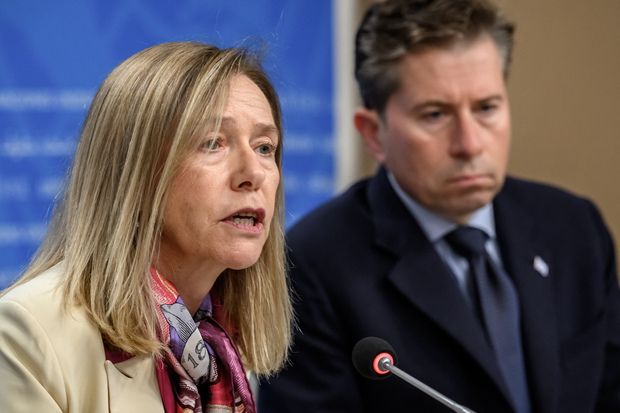
World Meteorological Organization (WMO) Secretary-general Celeste Saulo (L) speaks next to United Nations (UN) Under-Secretary-General for Humanitarian Affairs and Emergency Relief Coordinator Tom Fletcher during a joint press conference on the consequences of the unprecedented El Nino event in Geneva, on October 21, 2026. Photo by . (Photo by Fabrice COFFRINI / AFP via Getty Images)

The El Niño this year has been deemed by weather experts worldwide as a record-breaker.


“If this trajectory continues, it may be stronger than anything since our monitoring began,” World Meteorological Organization secretary-general Celeste Saulo told reporters at a press conference in Geneva back in September. “So literally off the charts we have used for the past four decades.”

According to the National Oceanic and Atmospheric Administration, during normal conditions in the Pacific Ocean, trade winds blow west along the equator, pushing warm water from South America towards Asia.

What is El Niño?
El Niño is a climate pattern that breaks normal conditions.

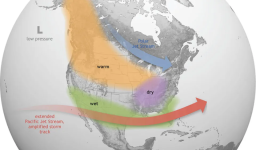
During El Niño, trade winds weaken and warm water is pushed toward the west coast of North America.

Trade winds are winds that blow east to west just north and south of the equator.

The warmer water causes the Pacific jet stream to move south of its neutral position. With this shift, areas in the northern U.S. and Canada are typically drier and warmer than normal.


Many Canadians will be familiar with the phenomenon, which can be associated with milder-than-usual winters.

weather
The El Nino effect on North America. Photo by National Oceanic and Atmospheric Administration,
Difficult to predict
So, what does that mean for the upcoming months for residents in southern Ontario?

Environment Canada’s current seasonal forecast is calling for above-normal temperatures across southern Ontario through the end of December, with precipitation expected to be in the normal range.

And if the strength of the current El Niño continues to hold sway, as it is predicted to do, Toronto could also see more precipitation falling as rain through the end of the year.

However, Environment Canada says it is still way too early to know for sure how the winter weather will play out through January to March.

However, the main expectation is a potentially warmer and drier winter and spring, with the possibility of less snow and a shorter snow season if the forecast develops as expected.

Even the Farmers Almanac seems to agree with a portion of the science.

“Canada is simply too vast for a one-size-fits-all winter forecast,” The Old Farmer’s Almanac editor-in-chief Carol Connare said. “This season, much of the south and far north are likely to enjoy milder-than-average conditions, while colder weather settles across parts of the middle of the country. Snow lovers may find plenty to celebrate in portions of both the east and west.”

ganderson@postmedia.com
1793253329116.png