


Is Timmy a Goyim like you too?He also does a pretty damn good Timmy impression.
Is Timmy a Goyim like you too?He also does a pretty damn good Timmy impression.
So good. We finally agree that June happened with Iran coming out on top and Israel unable to defend itself yet again today in daffodil month.In your mind I said this oil refinery I’d never heard of before a week ago wasn’t attacked eight months ago. What I’d said was why use footage from eight months ago when you’re try’n to prove something happened in the last week or two. Started about here:
View attachment 33593
View attachment 33594
View attachment 33595
Eight month old footage from June doesn’t prove something happened in the last two weeks. Doesn’t mean it didn’t, but doesn’t prove it did.
I was questioning why you were using 8 month old videos to claim proof of something was or had happened in the last week or two. Not that anything had or hadn’t happened, etc…
…& here we are is some bizarre loop.


And don't forget to blame the Iranians for wanting to be free?Thank you Bibi for making the entire world suffer ya fucking prick.
Only the extra fucking special kinda stupid Goyim believe that. If you weren't extra fucking special kinda stupid, you'd include Palestinians and Syrians living under al Qaeda in that claim.And don't forget to blame the Iranians for wanting to be free?
And don't forget to blame the Iranians for wanting to be free?
So the 75%-ish of the population that does not support the Cleric/IRGC doesn’t want to see change? Some percentage like that? What are you saying here?Only the extra fucking special kinda stupid Goyim believe that. If you weren't extra fucking special kinda stupid, you'd include Palestinians and Syrians living under al Qaeda in that claim.


Uhm…ok? Sure. Why not. Iran’s attacks on regional oil infrastructure and pledges to choke off maritime traffic left markets on edge Tuesday as the United States promised blistering new strikes. The war entered its 11th day with no end in sight as its effects were felt across the region and beyond.So good. We finally agree that June happened with Iran coming out on top and Israel unable to defend itself yet again today in daffodil month.
Your you obsession with a Korean family is odd.The Iranians, to a person, believe whatever petros says they believe. Anything else is the JOOS! manipulating the press (they do that, y'know).
Geez, whooda thunk Iran was so capable?Uhm…ok? Sure. Why not. Iran’s attacks on regional oil infrastructure and pledges to choke off maritime traffic left markets on edge Tuesday as the United States promised blistering new strikes. The war entered its 11th day with no end in sight as its effects were felt across the region and beyond.
Both sides sharpened their rhetoric as they dug in, with U.S. Defense Secretary Pete Hegseth again promising the most intense strikes yet, while Iran's leaders ruled out talks and directly threatened U.S. President Donald Trump.
Iran launched new attacks Israel and Gulf Arab countries, and Israel — America’s key ally in the fight — launched more airstrikes on Tehran and in Lebanon, where it is battling the Iran-backed Hezbollah.
At the Pentagon, Hegseth warned that Tuesday “will be yet again our most intense day of strikes inside Iran: The most fighters, the most bombers, the most strikes, intelligence more refined and better than ever.” He said “the last 24 hours have seen Iran fire the lowest amount of missiles they have fired yet.” Etc…
US and Iran dig in and ramp up threats as war rages with no end in sight — The Canadian Press
DUBAI, United Arab Emirates (AP) — Iran’s attacks on regional oil infrastructapple.news
Simple solution is to stamp out muslim terrorists. Oil flows, and Irainians can suffer democracy like the rest of us.Iran vowed on Tuesday that not one litre of oil would be exported from the Gulf while its war with the United States and Israel continues, in a stark rebuke to President Donald Trump's boast that the conflict was all but over.
Trump's argument that the war would be "ended soon" helped reverse the Monday's spike in oil prices, which have surged since Iranian attacks on shipping closed the Strait of Hormuz in response to the US-Israeli strikes that killed its supreme leader.
The price increase also followed strikes on oil depots in Iran and after attacks on oil infrastructure in Saudi Arabia and Bahrain.
View attachment 33596
Iran's Revolutionary Guards Corps (IRGC) mocked Trump's bid to lessen the economic impact of the war, warning: "The Iranian armed forces... will not allow the export of a single litre of oil from the region to the hostile side and its partners until further notice."
(Despite being a major oil producer, Canada imports oil to the East Coast due to limited domestic pipeline infrastructure connecting Western Canadian oil to eastern refineries. Canada imports very little, if any, natural gas from the Middle East, with Canadian Association of Petroleum Producersindicating that Canadian natural gas imports come primarily from the northeastern United States)
Iran's apparent confidence reflected that expressed by Trump, who gave a news conference in a Florida ballroom to declare of the war: "It's going to be ended soon, and if it starts up again they'll be hit even harder."
"We've already won in many ways, but we haven't won enough," Trump said?
The United States imports a relatively small and declining amount of oil from the Middle East, with Persian Gulf countries accounting for roughly 7% to 8% of total U.S. crude oil imports as of 2024–2025. Major Middle Eastern suppliers include Saudi Arabia and Iraq, while the vast majority of U.S. oil imports come from Canada.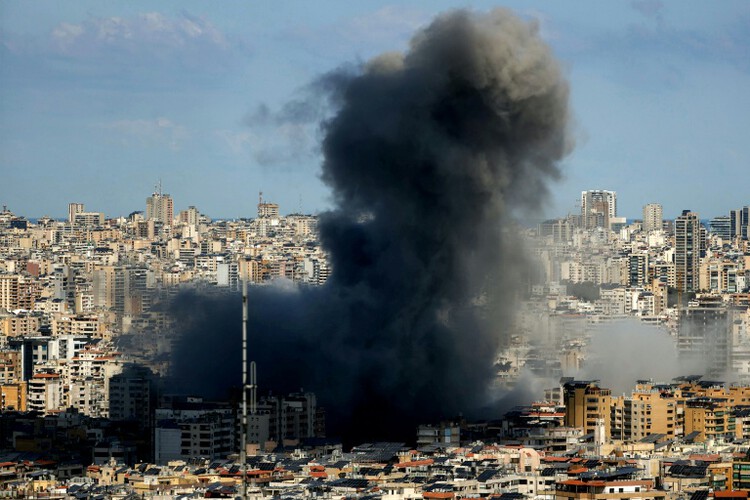
Iran vows to fight on and block all Gulf oil — AFP News
Iran vowed on Tuesday that not one litre of oil would be exported from the Gulf while its war with the United States and Israel continues, in a stark rebuke to President Donald Trump's boast that the conflict was all but over.
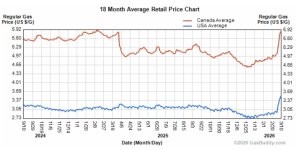
Gasoline and diesel prices in Western Canada have surged due to the Iran conflict disrupting global oil shipments through the Strait of Hormuz, where roughly 20% of the world's oil passes. Even though Canada produces its own oil, it is linked to the global market, causing prices to spike, with potential for further increases if the crisis continues, & Canadian pump prices are roughly 70% higher than Americans ‘cuz why not?
Who attacked whom?Simple solution is to stamp out muslim terrorists. Oil flows, and Irainians can suffer democracy like the rest of us.
And Pete wil quit inventing bullshit about how it is all the Jews fault.
Korea? Korea attacked somebody. You’d have to be more specific with respect to this because this is an ongoing goat rodeo.Who attacked whom?
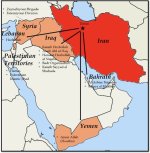
Iran, and or their proxies attacked Israel, merchant ships, and even their own citizens that didn't like the religious cults rules.Who attacked whom?
Your anti-Semitism is just same old, same old.Your you obsession with a Korean family is odd.
Yeah, you're an expert on Iranians. Yup, sure, whatever.Only the extra fucking special kinda stupid Goyim believe that. If you weren't extra fucking special kinda stupid, you'd include Palestinians and Syrians living under al Qaeda in that claim.
I don’t think anybody has said Iran wasn’t capable.Geez, whooda thunk Iran was so capable?
Who attacked whom?Korea? Korea attacked somebody. You’d have to be more specific with respect to this because this is an ongoing goat rodeo.
View attachment 33601
