Iran War. . . USA Up 2-0 in the First Period

petros

The Central Scrutinizer
Nov 21, 2008
119,902
14,807
113
Low Earth Orbit
As I was saying about Iran disabling missile defenses and radars....

IDF Says It Can't Guarantee It Will Send Alert for Missile Before Sirens Sound

Commenting on Friday's short notices, the IDF said that it cannot commit to a specific number of minutes between the warning and the activation of sirens. Meanwhile, satellite images show Iran is attempting to "blind" the United States and its allies by targeting radar systems

Gift this article
Share to X
Share
Comments:
3

Save
בר פלגOded Yaron
ירדן מיכאלי
Bar Peleg, Oded Yaronand Yarden Michaeli

01:08 PM • March 07 2026 IST
Following reports in Israel that rocket launch alerts on Friday were sent to mobile phones only moments before sirens

You're on your own....niiiiiice.
IDF Officials: Israel Bracing for Weeks-long Iran War, Warns Tehran May Ramp Up Missile Launches
Despite the damage to Iranian military assets, Israeli defense officials say that the Iranian regime doesn't seem to be losing clerks nor power. IDF officials say the war could continue for several more weeks, unless Trump abruptly halts it as he did in June's war

Gift this article
Share to X
Share
Comments:
9

Save
יניב קובוביץ
Yaniv KubovichFollow
08:07 PM • March 07 2026 IST
IDF officials say that Israel is preparing for the possibility that Iran will increase the rate of missile launches

Of course after blinding them...

Thank God Israeli news is still honest.
 

Ron in Regina

"Voice of the West" Party
Apr 9, 2008
31,550
11,450
113
Regina, Saskatchewan
"The first casualty of war is the truth" is a proverb meaning that during conflict, accurate information is sacrificed for propaganda, secrecy, and morale-boosting narratives. Often attributed to US Senator Hiram Johnson in 1917 or ancient Greek playwright Aeschylus, it highlights how facts are manipulated to maintain public support.

With the recent advent of AI, now you can’t even trust your own eyes without verifying.
 

petros

The Central Scrutinizer
Nov 21, 2008
119,902
14,807
113
Low Earth Orbit
"The first casualty of war is the truth" is a proverb meaning that during conflict, accurate information is sacrificed for propaganda, secrecy, and morale-boosting narratives. Often attributed to US Senator Hiram Johnson in 1917 or ancient Greek playwright Aeschylus, it highlights how facts are manipulated to maintain public support.

With the recent advent of AI, now you can’t even trust your own eyes without verifying.
It was hit. No fog, no truth causality, no covering it up.

With radar getting systematically being taken out, Israel's back is shoved into the wailing wall.

They're going to use nukes. Who wants that?
 

Ron in Regina

"Voice of the West" Party
Apr 9, 2008
31,550
11,450
113
Regina, Saskatchewan
So… this whole “Iran deploying cluster munitions against Tel Aviv” thing…why is it only YouTube videos from news outlets (or something like news outlets) from India, or Facebook, showing these things? And why do they only show them in the air and never hitting the ground?
 

petros

The Central Scrutinizer
Nov 21, 2008
119,902
14,807
113
Low Earth Orbit
So… this whole “Iran deploying cluster munitions against Tel Aviv” thing…why is it only YouTube videos from news outlets (or something like news outlets) from India, or Facebook, showing these things? And why do they only show them in the air and never hitting the ground?
Media blackout. Can't show losing. A very unpopular war for Israel will get even more unpopular.

There is one clip of what one of the clusters did. Pretty damn big hole.
 

Ron in Regina

"Voice of the West" Party
Apr 9, 2008
31,550
11,450
113
Regina, Saskatchewan
1773010848223.jpeg
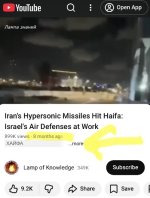
It’s another video from eight months ago.

Anyone who has picked up a newspaper over the past week can be forgiven for thinking we might be witnessing the start of World War III. Except for the fact that no one, other than Iran’s terrorist buddies in Hezbollah, is lining up on the side of the Islamic Republic.

(I think the Houthis out’a Yemen are in this to some extent too, but maybe not)

What started as joint U.S. and Israeli strikes targeting Iran’s theocratic regime on Feb. 28 quickly escalated as Iranian forces and their proxies began striking targets throughout the region.

Hezbollah entered the fray on Monday, drawing Israel into a multi-front war and attacking a British army base in Cyprus, a European Union member state.

Numerous European countries have since announced plans to send warships to the Mediterranean to protect the island nation, including France, which deployed a nuclear-powered aircraft carrier, Italy, Greece, Spain, the Netherlands and the United Kingdom, though its ship is not expected to set sail until next week.

There’s also a risk that NATO’s 32 members states could be drawn into the conflict, after Turkey announced on Wednesday that the alliance’s air defences had intercepted an incoming Iranian missile.

Iran has simultaneously been launching missiles and drones at its Gulf neighbours, including countries it has traditionally had friendly relations with.

According to data from the Israeli Institute for National Security Studies, as of Wednesday, Iran had fired more missiles and drones at Gulf states — including Bahrain, Kuwait, Oman, Qatar, Saudi Arabia and the United Arab Emirates — than at Israel.

Oil refineries have been targeted in Bahrain and Saudi Arabia, forcing the shutdown of Saudi’s largest refinery and one of its biggest oil export terminals, which will likely prove to be a red line for the oil-dependent country.

On Monday, Qatar made the case to the United Nations that it reserves the right to respond to Iranian aggression with force, while on Thursday, Azerbaijan threatened to retaliate after two drones crossed the border, hitting an airport and coming dangerously close to striking a school.

Tehran also launched attacks aimed at Kurdish forces in Iraq, amid reports that they’re preparing a ground invasion.

Meanwhile, Iran’s two closest allies, Russia and China, are nowhere to be found.
The U.S. accused Moscow of sharing intelligence on American interests in the Middle East with Tehran, but, bogged down with its own war in Ukraine, Russia does not appear interested in offering material support, with a Kremlin spokesperson stating bluntly that, “It’s not our war.”

Beijing has also limited its involvement to issuing strongly worded statements against the war.

It would appear as though Iran is betting that targeting its neighbours will cause them to put pressure on the U.S. to end its bombing campaign.

The strategy makes some sense, given that numerous Gulf states have already warned that their air defences are running dry, and experts are saying that stockpiles could run out in a matter of days.

Many of those countries are also far less able to withstand sustained aerial bombardments than Israel, where virtually everyone has a safe room or is within spitting distance of a bomb shelter, and are protected by the world’s most advanced missile shield.

Yet it is a strategy that so far does not appear to be working, and risks drawing more belligerents into the conflict against Iran.

This is the context in which Prime Minister Mark Carney appeared to change his tune over whether Canada could eventually get involved in some capacity.

It’s a bit rich for Ottawa to be so eager to come to the aid of the Arab dictatorships after spending the past two-and-a-half years leaving our traditional allies in Israel high and dry as they came under fire from all sides.

But keeping our options open is the correct position to take, especially if we can in any way help countries withstand sustained attacks, in what Iran is clearly hoping will turn into a war of attrition.

Indeed, the biggest risk right now does not come from Iran, which is in danger of running short on munitions, especially as the U.S. and Israel continue pummelling its missile launchers and weapons-production facilities.

The risk is that the U.S. will not have the fortitude to withstand a lengthy war, thus allowing a genocidal regime with nuclear ambitions to live to fight another day.

Canada’s dilapidated military can, of course, only do so much. But we have a treaty obligation to protect our NATO allies in Turkey and a moral obligation to ensure the mullahs in Tehran cannot continue to butcher their own people and fund terrorism around the world.

Ottawa’s ever-changing position on the conflict leaves much to be desired, but the Carney government may end up stumbling its way into doing the right thing in the end.
1773011745019.jpeg
 

Ron in Regina

"Voice of the West" Party
Apr 9, 2008
31,550
11,450
113
Regina, Saskatchewan
Based on reports from the conflict that began on February 28, 2026, Iran has been launching waves of missiles and drones at Israel, with several incidents impacting or showering shrapnel over urban centers in Israel, particularly in the Tel Aviv area.

As of March 8, 2026, the situation includes the following developments:
  • Continuous Attacks: Since Feb 28, Iran has launched over 165 "attack waves" using ballistic missiles and UAVs, with a significant number aimed at the Tel Aviv metropolitan area, northern Israel, and near Jerusalem.
  • Recent Impact: On March 8, 2026, a missile attack resulted in injuries in central Israel, with shrapnel from intercepted missiles causing damage in the Gush Dan region (Tel Aviv area).
  • Casualties and Damage: While the majority of missiles are intercepted by Israel's air defenses, Iranian strikes have caused casualties, including injuries from shrapnel and, in some cases, direct hits on buildings, such as a reported incident near Jerusalem earlier in the conflict.
  • Targeting Strategy: The attacks have deliberately focused on high-density civilian and economic centers to maximize psychological and physical impact.
  • Intensity Trends: After a peak of 55 attack waves on March 1, the number of daily waves has seen a relative, though fluctuating, decrease, with 12 waves identified on March 7.
The attacks are part of a broader, ongoing regional conflict following joint U.S.-Israel strikes on Iran that began on February 28, 2026.
 

petros

The Central Scrutinizer
Nov 21, 2008
119,902
14,807
113
Low Earth Orbit
View attachment 33584
It’s another video from eight months ago.

Anyone who has picked up a newspaper over the past week can be forgiven for thinking we might be witnessing the start of World War III. Except for the fact that no one, other than Iran’s terrorist buddies in Hezbollah, is lining up on the side of the Islamic Republic.

(I think the Houthis out’a Yemen are in this to some extent too, but maybe not)

What started as joint U.S. and Israeli strikes targeting Iran’s theocratic regime on Feb. 28 quickly escalated as Iranian forces and their proxies began striking targets throughout the region.

Hezbollah entered the fray on Monday, drawing Israel into a multi-front war and attacking a British army base in Cyprus, a European Union member state.

Numerous European countries have since announced plans to send warships to the Mediterranean to protect the island nation, including France, which deployed a nuclear-powered aircraft carrier, Italy, Greece, Spain, the Netherlands and the United Kingdom, though its ship is not expected to set sail until next week.

There’s also a risk that NATO’s 32 members states could be drawn into the conflict, after Turkey announced on Wednesday that the alliance’s air defences had intercepted an incoming Iranian missile.

Iran has simultaneously been launching missiles and drones at its Gulf neighbours, including countries it has traditionally had friendly relations with.

According to data from the Israeli Institute for National Security Studies, as of Wednesday, Iran had fired more missiles and drones at Gulf states — including Bahrain, Kuwait, Oman, Qatar, Saudi Arabia and the United Arab Emirates — than at Israel.

Oil refineries have been targeted in Bahrain and Saudi Arabia, forcing the shutdown of Saudi’s largest refinery and one of its biggest oil export terminals, which will likely prove to be a red line for the oil-dependent country.

On Monday, Qatar made the case to the United Nations that it reserves the right to respond to Iranian aggression with force, while on Thursday, Azerbaijan threatened to retaliate after two drones crossed the border, hitting an airport and coming dangerously close to striking a school.

Tehran also launched attacks aimed at Kurdish forces in Iraq, amid reports that they’re preparing a ground invasion.

Meanwhile, Iran’s two closest allies, Russia and China, are nowhere to be found.
The U.S. accused Moscow of sharing intelligence on American interests in the Middle East with Tehran, but, bogged down with its own war in Ukraine, Russia does not appear interested in offering material support, with a Kremlin spokesperson stating bluntly that, “It’s not our war.”

Beijing has also limited its involvement to issuing strongly worded statements against the war.

It would appear as though Iran is betting that targeting its neighbours will cause them to put pressure on the U.S. to end its bombing campaign.

The strategy makes some sense, given that numerous Gulf states have already warned that their air defences are running dry, and experts are saying that stockpiles could run out in a matter of days.

Many of those countries are also far less able to withstand sustained aerial bombardments than Israel, where virtually everyone has a safe room or is within spitting distance of a bomb shelter, and are protected by the world’s most advanced missile shield.

Yet it is a strategy that so far does not appear to be working, and risks drawing more belligerents into the conflict against Iran.

This is the context in which Prime Minister Mark Carney appeared to change his tune over whether Canada could eventually get involved in some capacity.

It’s a bit rich for Ottawa to be so eager to come to the aid of the Arab dictatorships after spending the past two-and-a-half years leaving our traditional allies in Israel high and dry as they came under fire from all sides.

But keeping our options open is the correct position to take, especially if we can in any way help countries withstand sustained attacks, in what Iran is clearly hoping will turn into a war of attrition.

Indeed, the biggest risk right now does not come from Iran, which is in danger of running short on munitions, especially as the U.S. and Israel continue pummelling its missile launchers and weapons-production facilities.

The risk is that the U.S. will not have the fortitude to withstand a lengthy war, thus allowing a genocidal regime with nuclear ambitions to live to fight another day.

Canada’s dilapidated military can, of course, only do so much. But we have a treaty obligation to protect our NATO allies in Turkey and a moral obligation to ensure the mullahs in Tehran cannot continue to butcher their own people and fund terrorism around the world.

Ottawa’s ever-changing position on the conflict leaves much to be desired, but the Carney government may end up stumbling its way into doing the right thing in the end.
View attachment 33585
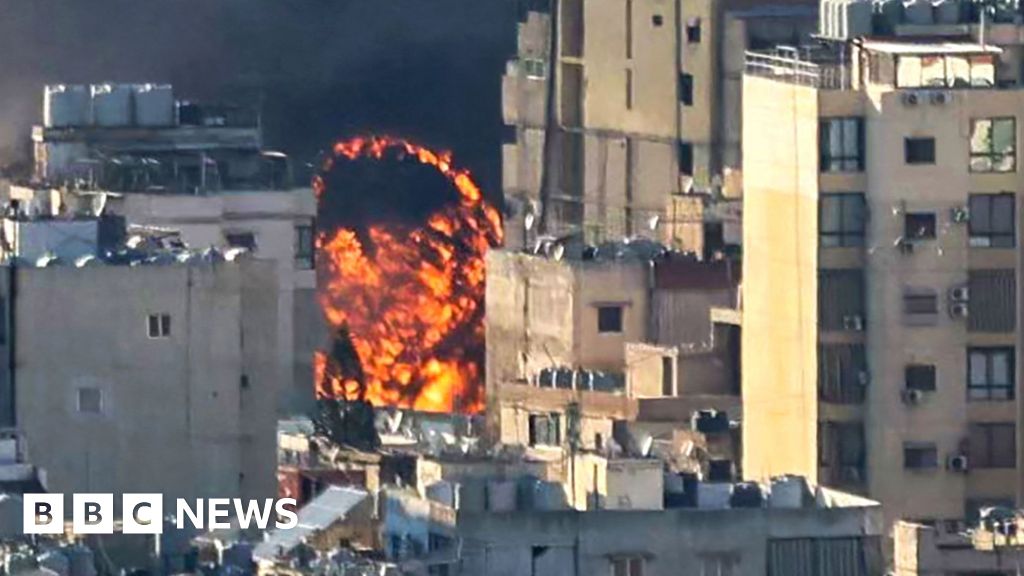
Nooooooope.

Hasbara.....if you get paid. Stupid Goyim.
 

Ron in Regina

"Voice of the West" Party
Apr 9, 2008
31,550
11,450
113
Regina, Saskatchewan
Nooooooope.

Hasbara.....if you get paid. Stupid Goyim.
Seriously, click on your own video in post 156 (or 115) & look at when it was posted.

Anyway, Bahrain says the latest Iranian attacks on the country have damaged a water desalination plant and injured three people as Tehran continues its air campaign against its Gulf neighbours.

In a statement on X, the Bahraini Ministry of Interior said an Iranian drone attack on Sunday morning damaged the desalination plant, which processes seawater to supply freshwater to residents.

“The Iranian aggression randomly bombs civilian targets and causes material damage to a water desalination plant following an attack by a drone,” the ministry statement said.
1773026171563.jpeg
Fuel tanks at Kuwait’s international airport were targeted in a drone attack, the military said. The official Kuwait News Agency said a fire at the airport was brought under control, reporting no “significant injuries”. The military called the Iranian drone attack “a direct targeting of vital infrastructure”.

Strikes were also reported in the United Arab Emirates at the US consulate in Dubai and a port in the city of Fujairah.The UAE’s Defence Ministry said its defences downed three ballistic missiles and 121 drones, while eight drones landed inside the country.
Saudi ⁠Arabia’s defence ministry said it ⁠intercepted and destroyed a drone ‌in the country’s Eastern Province. It did not immediately ⁠provide further ⁠details on the drone’s ⁠origin or ⁠whether ⁠the incident caused any damage ‌or casualties.

Later in the day, a projectile hit Saudi Arabia’s Ras Tanura refinery, the biggest domestic oil refinery operated by Saudi Aramco, according to two sources cited by Reuters. The report comes after Saudi Arabia shut down operations at the plant several days ago after a fire broke out that officials said was caused by debris from the interception of two Iranian drones.

Qatar’s Defence Ministry said it intercepted 10 drones and two cruise missiles launched from Iran. Qatar Airways said its flight operations remained “temporarily suspended due to the closure of Qatari airspace”.
Saudi Arabia, the United Arab Emirates and Qatar also reported more Iranian attacks on Saturday and Sunday.
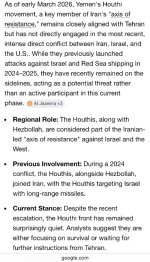
As of March 2026, Iran’s alliance structure, known as the Axis of Resistance, is facing significant strain. Key regional allies include Hezbollah (Lebanon), the Houthi movement (Yemen), and various Iraqi militias, though many have hesitated to directly engage in recent conflicts, leading to accusations of an "axis of reluctance".