The Donroe Doctrine

Ron in Regina

"Voice of the West" Party
Apr 9, 2008
31,302
11,369
113
Regina, Saskatchewan
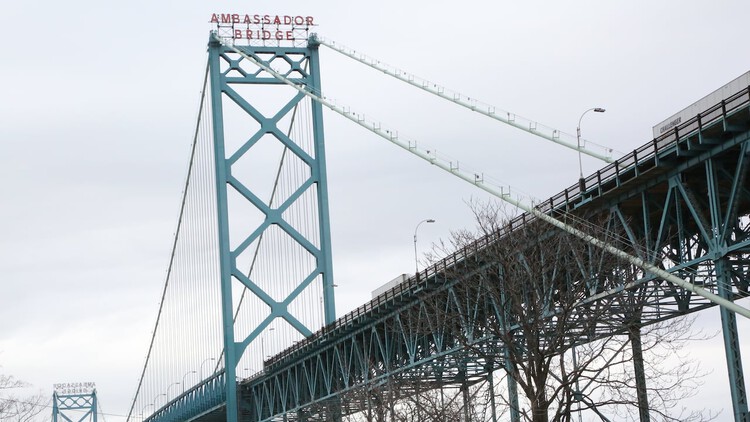
Windsor Ontario Mayor Dilkens noted a New York Times report saying that Matthew Moroun, the Detroit-based owner of the Ambassador Bridge spoke with U.S. secretary of commerce Howard Lutnick Monday afternoon.

Lutnik then spoke with Trump, according to the report, which cited two confidential sources. Then, on Monday evening, Trump posted on Truth Social that he would not allow the Gordie Howe International Bridge to open until the United States owned half? Coincidentally coincidental?

(James Blanchard, a former U.S. ambassador to Canada and governor of Michigan said there are ties between the Trump White House and the Moroun family. "In the previous administration, they gave a lot of money to Mr. Trump's inauguration," Blanchard said, noting the family's long history of opposition to the Gordie Howe bridge)

Moroun and his family have owned the Ambassador Bridge since 1979. The Canadian Transit Company (CTC) owns the Canadian half of the bridge, and that company is then owned by the Detroit International Bridge Company, owned by the Moroun family…& not at least 1/2 by America? I’m shocked!!😳

The bridge company has long launched bids to try and stop the Gordie Howe from opening because it will reduce the traffic on the Ambassador. Ahhhhhh….

The bridge company has long launched bids to try and stop the Gordie Howe from opening because it will reduce the traffic on the Ambassador.

Dilkens said he understands Moroun's position on the new bridge — but that it's about enhancing trade and adding redundancy so crucial trade can continue to flow.

About $400 million in trade flows across the Ambassador Bridge between Windsor and Detroit daily, according to the Canadian federal government, and the company says crossing is the busiest land border crossing in North America.

Recently, a judge ruled that the legal case involving the federal government and the Canadian Transit Company should head to trial — over the issue of whether the CTC has the exclusive rights to collect tolls at border crossings in west Windsor, based on a piece of legislation more than 100 years old. (???)

The Canadian federal government had motioned for a summary judgement— asking for the case to be dismissed without a trial, arguing that it was "plain and obvious" that the 1921 law, the Canadian Transit Company Act, didn't grant the company exclusive rights.
Queer how Trumps tirade mentions China cancelling hockey and taking the Stanley Cup away…but not this?
 

Ron in Regina

"Voice of the West" Party
Apr 9, 2008
31,302
11,369
113
Regina, Saskatchewan
“‘It’s never been my intention to make Greenland the 51st state,’” the Post quoted Trump saying. “I want to make Canada the 51st state. Greenland will be the 52nd state. Venezuela can be 53rd.’”
So…Cuba can be the 54th state then?
(YouTube & Why does Trump want to break Cuba?)
1770942238225.jpeg
As the sun came up on a flat calm Florida Straits, two ships arrived off the port of Havana: the Isla Holbox, a squat logistics ship, followed by the more aggressive looking Papaloapan, whose bow ramp gave the appearance of a large beetle.

The two Mexican navy ships docked on Thursday laden with humanitarian aid as part of Mexico’s efforts to support Cuba amid a deepening crisis exacerbated by Donald Trump’s economic pressure campaign.

The boats, carrying more than 800 tons in aid, arrived at the Caribbean nation two weeks after Trump signed an executive order allowing the US to slap tariffs on any country selling or providing oil to Cuba, effectively choking off fuel to the island.
The Isla Holbox carried some 536 tons of food including milk, rice, beans, sardines, meat products, cookies, canned tuna and vegetable oil, as well as personal hygiene items. The Papaloapan carried just over 277 tons of powdered milk, according to the Mexican government.

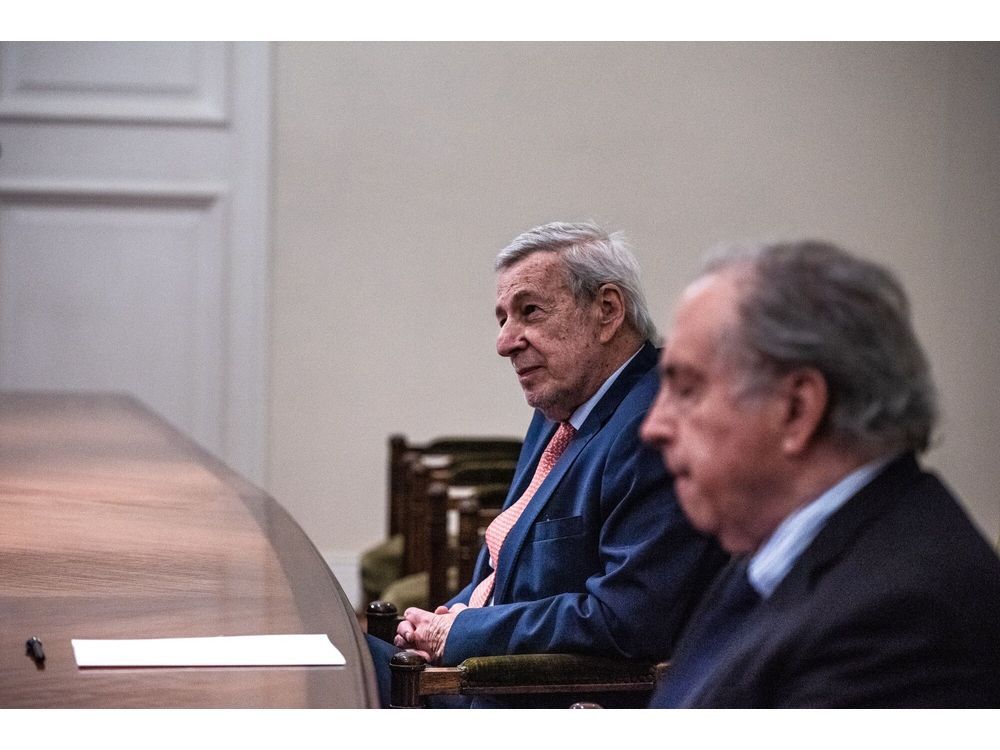
Chile will provide monetary assistance through multilateral organizations, Foreign Affairs Minister Alberto van Klaveren told reporters. When asked if the Chilean administration is concerned about any retaliation from Donald Trump — whose administration has pressured nations to cease oil shipments to Cuba — he replied that “the US won’t object to humanitarian aid.”
(YouTube & Cuba receives humanitarian aid from Mexico as Trump’s blockade bites)
 

Ron in Regina

"Voice of the West" Party
Apr 9, 2008
31,302
11,369
113
Regina, Saskatchewan
Cuba’s latest crisis follows an ‘American’ executive order signed by Donald Trump in January imposing tariffs on any country supplying Cuba with oil. Despite outrage from Cuba’s traditional allies China and Russia, the threat has proved effective.
1771178499049.jpeg
Even Mexico, which last year supplanted Venezuela as the island’s largest supplier, has ceased sending tankers, although its president, Claudia Sheinbaum, warned of a humanitarian disaster on the island and sent 800 tons of aid. “No one can ignore the situation that the Cuban people are currently experiencing because of the sanctions that the United States is imposing in a very unfair manner,” she said on Tuesday.

Among the verdant gardens of Havana’s diplomatic quarter, Siboney, ambassadors from countries ‘traditionally’ allied to the United States are expressing increasing frustration with Washington’s attempt to unseat Cuba’s government, while simultaneously drawing up plans to draw down their missions.
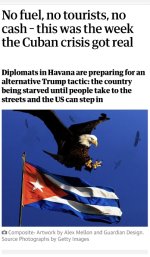
1771179398160.jpegCuba is in crisis. Already reeling from a four-year economic slump, worsened by hyper-inflation and the migration of nearly 20% of the population, the 67-year-old communist government is at its weakest. After Washington’s successful military operation against Cuba’s ally Venezuela at the beginning of January, the “US administration is actively seeking regime change.”

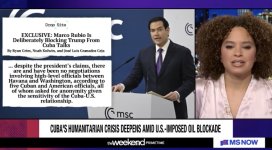
The Guardian spoke to more than five top-level officials from different countries, and heard complaints that the US charge d’affaires, Mike Hammer, has failed to share any sort of detailed plan beyond bringing the island to a standstill by starving it of oil. One said: “There’s talk of human rights, and that this is the year Cuba changes – but little talk of what happens afterwards.”
1771183748379.jpeg
At a party at the US residence on 28 January, Hammer referred to the 68-year US embargo on the island, telling guests: “The Cubans have complained for years about ‘the blockade’, but now there is going to be a real blockade.”
He began a tour of eastern Cuba shortly afterwards…
1771203027475.jpeg
(away from Havana, & over by Guantanamo Bay that America considers theirs already)

…distributing US aid, during which small groups of government-backed protesters met him with abuse. He is now believed to be heading to Rome for discussions with the Vatican, increasingly a force on the island.

The consequences of the US oil blockade have arrived faster than anyone expected, adding to diplomats’ concerns. All three airlines flying tourists into Cuba from Canada suspended their services this week due to a lack of aviation fuel on the island. Two Russian airlines followed. All five carriers have begun the process of repatriating travellers.

As the oil blockade’s crippling effect on the Cuban government’s ability to earn foreign exchange takes hold, Cubans outside the diplomatic enclaves have begun preparing for life without fuel. “It is starting to feel like the 1962 missile crisis,” said one. “The sun was shining then too, and people went about their business, under a cloud of anxiety.”
Cuba’s government has already shut universities, secondary schools and non-essential state offices and pulled back on public transport in order to preserve resources.

A man in La Lisa neighbourhood in Havana is making cast aluminium and galvanised zinc burners for people to cook over wood. At $8 for a single burner and $15 for a double, his tools are proving popular.

“My mother is going crazy with this cooking on charcoal,” said a woman in the rural mid-Cuban town of Sancti Spíritus, who then asked to remain anonymous because otherwise she would have to “make a will to bequeath the charcoal stove to my daughter as her only inheritance”.

Meanwhile, diplomats have been making plans to leave if the situation quickly deteriorates. “What is the point of us being here if we can’t work?” asked one. “We’re prepared, vigilant, and hoping common sense keeps winning a few rounds,” said another.

In the centre of Havana, hotspots that have made the city one of the world’s most loved tourist destinations are falling quiet. Yarini is one of the hippest rooftop bars, named after a famously anti-American pimp of the early 1900s.

Usually it seethes, but on a warm weekday night, only two tables were occupied. Neither of the groups turned out to be local people or regular tourists. Instead they were war correspondents taking a break from winter in Ukraine, in the hope of covering the fall of one of the world’s last communist states.
 

Ron in Regina

"Voice of the West" Party
Apr 9, 2008
31,302
11,369
113
Regina, Saskatchewan
Trump on Monday railed against Canada by threatening it over a bridge and then warning that China wanted to “terminate” hockey in Canada and “permanently eliminate the Stanley Cup.”
1771211692679.jpeg
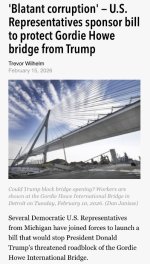
“Trump’s threat to block the Gordie Howe International Bridge is a spit in the face to Detroiters who have been patiently awaiting its opening,” said Rep. Shri Thanedar. “Thanks to the incredible diplomacy of President Obama, Canada paid the entire cost of the bridge, all while supporting American workers by hiring them to work on its construction and using American steel to build it. We were getting a bridge at no cost to us, but Trump is recklessly threatening to throw all of that away for no other reason than to inflict pain on Michiganders and Canadians alike.”
1771211801659.jpeg
Thanedar and fellow U.S. Representatives Hillary Scholten, Debbie Dingell, Haley Stevens, Rashida Tlaib, and Kristen McDonald Rivet introduced the Michigan-Canada Partnership Act to Protect the Gordie Howe International Bridge Project last week.

The bill aims to prevent “federal interference” in the opening and operation of the bridge.

The U.S. Representatives made the move after Trump pledged to block the bridge’s opening on Feb. 9 in a rambling, falsity-filled Truth Social post. His inaccurate statements included a claim that Canada owns both sides of the Gordie, and no American steel or labour was used to build it.
The president’s bizarre comments left Jimmy Kimmel baffled. “Did he get hit in the brain with a hockey puck or something? I mean, seriously. China is gonna ban hockey in Canada?” he said. “We got a code orange demental emergency going on here right now. He’s gone. He’s totally gone.”
Seemingly unaware that the Gordie Howe bridge is jointly owned by Canada and Michigan, Trump also demanded that the U.S. own “at least one half of this asset.”

I will not allow this bridge to open until the United States is fully compensated for everything we have given them,” Trump wrote?

The New York Times later reported — citing unnamed sources — that Trump’s post followed a meeting hours earlier between U.S. Secretary of Commerce Howard Lutnik and Matthew Moroun, the billionaire private owner of the Ambassador Bridge.🤔

California congressman Robert Garcia, a ranking member of the U.S. House Oversight Committee, issued a letter last week demanding documents detailing that reported meeting along with the Trump White House’s other communications with the Morouns.

A representative of the Ambassador Bridge company has not acknowledged several requests for comment from the Star. The company has spent more than a decade — and millions of dollars — trying to thwart government efforts to build a competing publicly owned bridge.

The congress members said in their joint statement that construction of the bridge “has enjoyed years of bipartisan support.” In 2012, Michigan entered into a bilateral agreement with Canada to advance construction of the bridge without direct cost to Michigan taxpayers.

They said the agreement was executed under Michigan’s former Republican Gov. Rick Snyder and in cooperation with former Democrat President Barack Obama, “demonstrating the project’s nonpartisan importance to American workers, manufacturers, and national competitiveness.”

The U.S. Representatives also pointed out that during his first presidential term, Trump was a vocal supporter of the bridge. In 2017, he issued a joint statement with then-Prime Minister Justin Trudeau, pushing for the “expeditious completion” of the Gordie Howe bridge. “Donald Trump won Michigan, and now he’s turning his back on the working people who put him in office.”

Hmmmm…wonder what Trumps plan is regarding those mid-terms again? “Instead of fighting for Michigan workers and our economy, he’s protecting his billionaire donors. In 2017, Trump himself endorsed the bridge, calling it a ‘vital economic link between our two countries.’ Nothing has changed. Canada is our friend, our neighbor, and one of our strongest allies.”
“The Gordie Howe International Bridge is the product of years of cross-border work, investment, and cooperation and is ready to open this spring,” said Tlaib. “It’s no surprise that Matthew Moroun, owner of the dangerously obsolete Ambassador Bridge, met with the Trump Administration mere hours before the president absurdly threatened to block this safer, more efficient bridge from opening. Michiganders and the American people will not be denied this crucial new crossing by the White House’s blatant corruption.”

Secretary of Commerce Howard Lutnik and Matthew Moroun, the billionaire private owner of the Ambassador Bridge, met only hours before Trumps flip-flop position on this. During his first presidential term, Trump was a vocal supporter of the bridge. In 2017, he issued a joint statement with then-Prime Minister Justin Trudeau, pushing for the “expeditious completion” of the Gordie Howe bridge.
 

Ron in Regina

"Voice of the West" Party
Apr 9, 2008
31,302
11,369
113
Regina, Saskatchewan
Canadian Conservatives got the U.S. President they wanted.
At this point, I’m not even sure if the U.S. Conservatives got the President they wanted.

Presidential oversight in the United States, which involves checks on executive power by Congress and the judiciary, operated differently during the Trump administration, characterized by significant tension, legal challenges, and extensive litigation. While formal oversight mechanisms—such as congressional hearings, Inspector General reports, and court reviews—remained in place, the administration frequently resisted compliance, leading to debates about the "reality" or effectiveness of this oversight.

The U.S. Department of the Treasury’s Office of Foreign Assets Control (OFAC) administers and enforces U.S. economic and U.S. trade sanctions based on U.S. foreign policy and U.S. national security goals. It targets foreign countries, regimes, terrorists, narcotics traffickers, and threats to U.S. national security by freezing assets and restricting transactions…globally.

OFAC imposes controls on transactions and freezes assets under U.S. jurisdiction…globally. Let that sink in. OFAC maintains the Specially Designated Nationals (SDN) List, identifying individuals and entities owned or controlled by, or acting for, targeted countries or groups, and we’ve seen how fickle Trump controlled enemies lists can be.

OFAC issues general or specific licenses to authorize transactions that would otherwise be prohibited. It acts under Presidential national emergency powers and specific legislation, and thankfully those powers would never be abused for personal gain or purely vindictive purposes.
Based on reports from early 2025 and early 2026, the U.S. Treasury Department’s Office of Foreign Assets Control (OFAC) operates under the Office of Terrorism and Financial Intelligence (TFI), which is led by an Undersecretary reporting directly to the Secretary of the Treasury, who in turn reports to the President.

As of February 2026, the Trump administration has utilized OFAC as a primary tool for foreign policy, with sanctions targeting countries such as Iran, Venezuela, and China so far. Under the Trump administration, sanctions are driven by Executive Orders designed to target specific regimes and economic sectors, acting as a direct extension of administration policy.