


The British Establishment thinks it can ignore the people's democratic decision and allow Britain to leave the EU in name only without there being any repercussions.
But it seems to have forgotten one thing: Ukip...
Features
Ukip is back thanks to the Chequers backlash
Theresa May’s approach to Brexit is providing the ideal conditions for the party’s revival
Matthew Goodwin

Matthew Goodwin
28 July 2018
The Spectator
The UK Independence Party might be about to make a comeback. Ever since Theresa May’s Chequers deal on Brexit, which went down very badly indeed among grassroots Conservatives and Leavers, the opinion polls have been kind to the Purple Army.
The week after the Chequers deal went public, one pollster found support for the party had surged by five points to 8 per cent. It might not sound like much, but it is its best showing since March last year. Furthermore, such numbers are more than enough to tilt the balance at the next general election toward Jeremy Corbyn and Labour.
Indeed, it is no coincidence that as Ukip recovered in the polls, the Conservatives found themselves trailing Labour, with one survey handing Jeremy Corbyn a five-point lead — his second highest of the year (Corbyn only needs a two-point swing to get into coalition territory and a five-point swing for a majority). Amid a tight race with Labour, the Tories cannot afford a rebooted revolt on the right.
There are other signs that the self-anointed People’s Army might be about to come off life support. One insider tells me that the party has attracted 2,500 new members since Chequers and around 3,000 in total since the spring. Membership is still a long way from the peak of 40,000 recorded during 2014-2015, but with an estimated 23,000 recruits this still represents a sizeable rebellion to the right of the Conservatives.
More recent polls suggest that nearly 40 per cent of all voters would be open to supporting a new party that was firmly committed to Brexit (which surges to 67 per cent of Conservative voters), while 24 per cent would support an explicitly far-right, anti-immigrant and anti-Islamism party, which should sound a warning note. Ukip 2.0 may well be distinctly less cuddly than the original. It should also be remembered that today we are dealing with an electorate that is far more fluid and less tribal than in earlier years. The perfect cocktail to revive Ukip was never hard to find; start with a ‘BRINO’ (Brexit In Name Only), throw in a liberal immigration policy that looks and sounds a lot like freedom of movement, then add a splash of political denial in Westminster. It is therefore no surprise to find Ukip enjoying a renaissance as a radical right party.
None of this has escaped the attention of Nigel Farage, who stepped down as Ukip’s leader in July 2016 but who is clearly mulling a possible return to the ring. Farage has already committed himself to returning to frontline politics if Article 50 is suspended. But in recent days he went further by stating he would ‘very seriously consider’ putting his name forward to run as Ukip leader if the Chequers compromise is not broken and Brexit is not put ‘back on track’.
All of this flies in the face of earlier predictions that populism is dead in Britain. The argument that the 2016 Brexit referendum had finally put a lid on backlash politics was never a particularly convincing one. On the contrary, the emergence of an army of ‘betrayed Brexiteers’ always looked likely given the mismatch between the vision of Brexit held by many in Westminster and the much cleaner break from Europe favoured by grassroots conservatives.
A similarly flawed argument did the rounds in Brussels and went a bit like this: to show their opposition to the British, Europeans have turned their backs on anti-EU populist parties. Two years on and take a look around Europe: the populist Sweden Democrats (who want a Swexit) just reached no. 1 in the polls; the populist Alternative for Germany are no. 2; the populist Northern League and Five Star are running Italy; the populist Freedom Party is in a coalition in Austria; Slovenia has lurched right; and more than six in ten Hungarians are backing Viktor Orbán’s Fidesz or the formerly neo-fascist Jobbik. If this is a Europe where populism is in full retreat, then I would hate to see the alternative.

Ukip leader Gerard Batten
Back in Britain, several tributaries now seem to be flowing toward Ukip, or at least the space previously occupied by the party. The largest comprises angry Eurosceptics and grassroots social conservatives who feel betrayed by Brexit. Consider their reaction to the current state of affairs: 76 per cent of Leavers feel that the Prime Minister’s government is negotiating Brexit ‘badly’; 66 per cent believe her vision of Brexit is ‘too soft’; nearly 60 per cent think that the Chequers deal disrespects the referendum result; and half want Mrs May to resign. In fact, among all voters, the Prime Minister’s leadership ratings this week sunk to a record low, while among Leavers her net positive rating has crashed from +10 to -23 in only two months.
These numbers are dismal for a Prime Minister who sought to speak for social conservatives in a way that David Cameron did not. But they are also especially problematic for a Conservative party that since the 2016 referendum has become more dependent on the groups that voted for Brexit; the working-class, true-blue Tories, and non–graduates, many of whom had also voted Ukip in the past. Put simply, this is a profoundly different electorate from that which supported Cameron in 2015 — it is more pro-‘hard’ Brexit, more opposed to immigration and more socially conservative. Some 70 per cent of Tory voters now regard themselves as Leavers. The problem for the Prime Minister and indeed the Tory party is not simply that their voters are disgruntled with the direction of Brexit but that it is precisely those voters who have a pre-existing relationship with Ukip who feel so angry.
But it would be a mistake to view Ukip’s recent recovery solely as a result of the Tory fallout. Also important is how a handful of prominent right-wing social media activists, who typically eschew party politics, have called on their (hundreds of thousands) of followers to enrol in Ukip. Paul Joseph Watson might be an unfamiliar name to readers but he has amassed around 882,000 followers on Twitter by attacking political correctness, Islam, refugees, identity liberalism and what he and his audience argue is excessive virtue signalling across the West.
Figures such as Watson, as well as Raheem Kassam — Nigel Farage’s former chief of staff and a close ally of Steve Bannon — are linked to an increasingly international campaign to support the jailed Tommy Robinson, ex-leader of the English Defence League. His supporters argue that he has been silenced from reporting on ‘grooming gangs’ and other Islam-related topics due to political correctness and a clampdown on free speech (Robinson was actually imprisoned for contempt of court.)
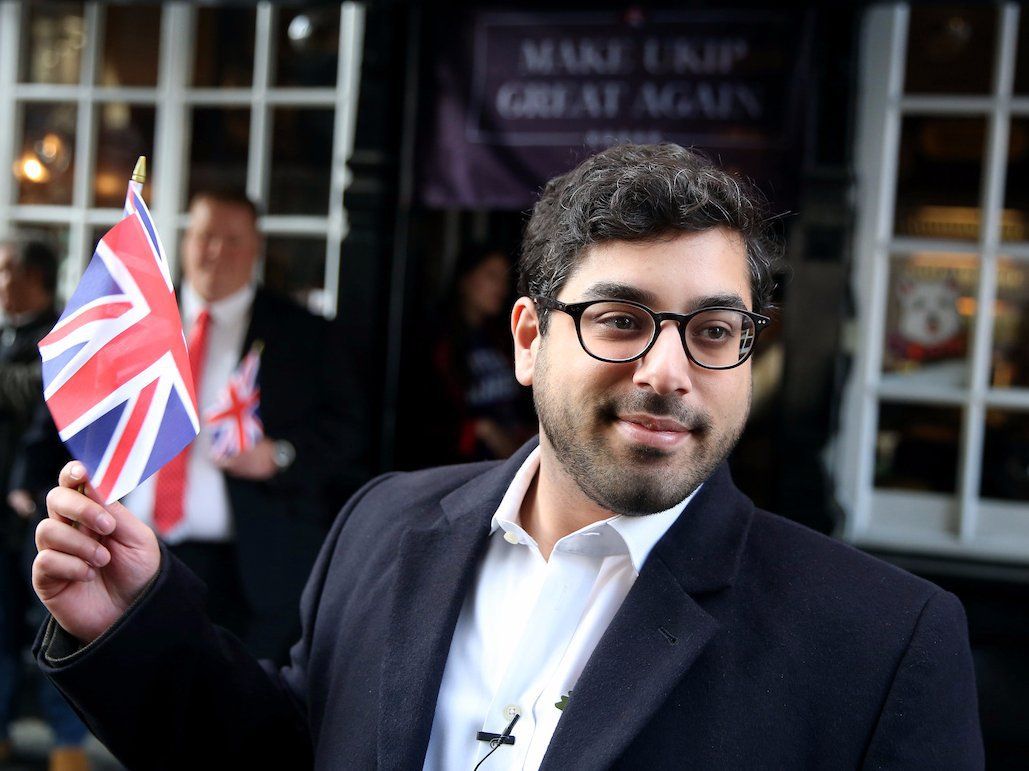
Ukip's Raheem Kassam — Nigel Farage’s former chief of staff and a close ally of Steve Bannon — is linked to an increasingly international campaign to support the jailed Tommy Robinson, ex-leader of the English Defence League
Unlike the Ukip of old, the party’s current leader, Gerard Batten, has been more than willing to enter this orbit in the search for new members and resources, developing links with the pro-Robinson campaign and other groups such as the Democratic Football Lads Alliance. Batten shares many of their views, having variously referred to Islam as a ‘death cult’, described Muhammad as a ‘paedophile’ and warned of an ‘explosion’ of mosques across Europe. To these tributaries we can also add blue-collar workers in more northern Labour seats who loathe the social liberalism and internationalism of their mainly middle-class MPs, and who are looking for meaningful reform on the issue of freedom of movement.
This is a long way away from the climate to which Ukip had become accustomed after the Brexit vote. In the shadow of the Brexiteers’ historic triumph, the party seemed destined for the political graveyard. It took two decades to find political relevance — and less than two years to stage a dramatic collapse. It shed members, money and morale, as well as Farage, who traded politics for media. Ukip also whittled through three leaders, each as ineffectual as the last. Diane James, Paul Nuttall and Henry Bolton each proved unable to halt what looked set to be an inevitable decline. Between the 2015 and 2017 general elections, the party haemorrhaged 3.2 million voters and saw its vote share crash by more than ten points to a derisory 1.8 per cent. Further humiliation followed at this year’s local elections when Ukip did not even qualify for an election broadcast and lost all but three of the 126 seats it was defending, prompting one Kipper to compare his party to the Black Death.
But amid the favourable turn of events, Ukip also finds itself faced with some big questions. The most obvious is whether the party can exploit the current openings. Some insiders openly voice doubts about Batten, including his willingness to indulge toxic groups that would alienate the much larger audience of middle-class conservatives. Explaining the markedly different fortunes of the far-right BNP with the pre-2016 Ukip would not be a difficult essay question to answer. Some also voice anxiety over Batten’s reluctance to engage wholeheartedly with the media.
Another problem is that not everybody in Ukip Land would necessarily welcome the return of Farage. Some influential activists feel that their former leader vacated the pitch at a crucial moment and has since spent more time on the search for media exposure and money than on the battle for Brexit. In the words of one insider: ‘Nigel just assumes that he can walk back in now things are looking good. But he’s spent the past few years slagging off the party, has pissed off a lot of people and also threw his weight behind a series of weak leaders. Batten is the only one who has stabilised us.’ There is also frustration among some senior Kippers that Farage has not fully put his support behind the party: ‘Batten can do things that Nigel cannot, like organise shit at the grassroots level. Nobody is pretending Gerard is a media performer like Nigel, but the thing that grates for a lot of people is that Nigel is not even using his platforms to tell people to join Ukip.’
Meanwhile, some donors are anxious to avoid the return of the divisive Arron Banks, a close ally of Farage, and have let it be known they would withdraw their funding if the old gang were once again to dominate the party. So, while there is unquestionably new demand for a Ukip-style party, the question is whether Ukip as it stands can supply this audience with a unified message and membership — and whether Farage is capable of leading it.
One of the unwritten laws in politics is that challenger parties don’t last long. Either their clothes are stolen by the mainstream, they implode amid infighting, or the political debate simply moves on. It was their short lifespan that led the historian Richard Hofstadter to observe more than half a century ago that challengers are like bees: once they have stung, they die. But in Britain this unwritten law could be about to be tested. Things are looking up for Ukip — it may well be that it is more of a wasp than a bee, and could yet deliver further stings to Britain’s increasingly volatile political system.
Spectator.co.uk/podcast Matthew Goodwin and Joe Twyman on Ukip.
https://www.spectator.co.uk/2018/07/ukip-is-back-thanks-to-the-chequers-backlash/
But it seems to have forgotten one thing: Ukip...
Features
Ukip is back thanks to the Chequers backlash
Theresa May’s approach to Brexit is providing the ideal conditions for the party’s revival
Matthew Goodwin
Matthew Goodwin
28 July 2018
The Spectator
The UK Independence Party might be about to make a comeback. Ever since Theresa May’s Chequers deal on Brexit, which went down very badly indeed among grassroots Conservatives and Leavers, the opinion polls have been kind to the Purple Army.
The week after the Chequers deal went public, one pollster found support for the party had surged by five points to 8 per cent. It might not sound like much, but it is its best showing since March last year. Furthermore, such numbers are more than enough to tilt the balance at the next general election toward Jeremy Corbyn and Labour.
Indeed, it is no coincidence that as Ukip recovered in the polls, the Conservatives found themselves trailing Labour, with one survey handing Jeremy Corbyn a five-point lead — his second highest of the year (Corbyn only needs a two-point swing to get into coalition territory and a five-point swing for a majority). Amid a tight race with Labour, the Tories cannot afford a rebooted revolt on the right.
More recent polls suggest that nearly 40 per cent of all voters would be open to supporting a new party that was firmly committed to Brexit (which surges to 67 per cent of Conservative voters), while 24 per cent would support an explicitly far-right, anti-immigrant and anti-Islamism party, which should sound a warning note. Ukip 2.0 may well be distinctly less cuddly than the original. It should also be remembered that today we are dealing with an electorate that is far more fluid and less tribal than in earlier years. The perfect cocktail to revive Ukip was never hard to find; start with a ‘BRINO’ (Brexit In Name Only), throw in a liberal immigration policy that looks and sounds a lot like freedom of movement, then add a splash of political denial in Westminster. It is therefore no surprise to find Ukip enjoying a renaissance as a radical right party.
None of this has escaped the attention of Nigel Farage, who stepped down as Ukip’s leader in July 2016 but who is clearly mulling a possible return to the ring. Farage has already committed himself to returning to frontline politics if Article 50 is suspended. But in recent days he went further by stating he would ‘very seriously consider’ putting his name forward to run as Ukip leader if the Chequers compromise is not broken and Brexit is not put ‘back on track’.
All of this flies in the face of earlier predictions that populism is dead in Britain. The argument that the 2016 Brexit referendum had finally put a lid on backlash politics was never a particularly convincing one. On the contrary, the emergence of an army of ‘betrayed Brexiteers’ always looked likely given the mismatch between the vision of Brexit held by many in Westminster and the much cleaner break from Europe favoured by grassroots conservatives.
A similarly flawed argument did the rounds in Brussels and went a bit like this: to show their opposition to the British, Europeans have turned their backs on anti-EU populist parties. Two years on and take a look around Europe: the populist Sweden Democrats (who want a Swexit) just reached no. 1 in the polls; the populist Alternative for Germany are no. 2; the populist Northern League and Five Star are running Italy; the populist Freedom Party is in a coalition in Austria; Slovenia has lurched right; and more than six in ten Hungarians are backing Viktor Orbán’s Fidesz or the formerly neo-fascist Jobbik. If this is a Europe where populism is in full retreat, then I would hate to see the alternative.
Ukip leader Gerard Batten
Back in Britain, several tributaries now seem to be flowing toward Ukip, or at least the space previously occupied by the party. The largest comprises angry Eurosceptics and grassroots social conservatives who feel betrayed by Brexit. Consider their reaction to the current state of affairs: 76 per cent of Leavers feel that the Prime Minister’s government is negotiating Brexit ‘badly’; 66 per cent believe her vision of Brexit is ‘too soft’; nearly 60 per cent think that the Chequers deal disrespects the referendum result; and half want Mrs May to resign. In fact, among all voters, the Prime Minister’s leadership ratings this week sunk to a record low, while among Leavers her net positive rating has crashed from +10 to -23 in only two months.
These numbers are dismal for a Prime Minister who sought to speak for social conservatives in a way that David Cameron did not. But they are also especially problematic for a Conservative party that since the 2016 referendum has become more dependent on the groups that voted for Brexit; the working-class, true-blue Tories, and non–graduates, many of whom had also voted Ukip in the past. Put simply, this is a profoundly different electorate from that which supported Cameron in 2015 — it is more pro-‘hard’ Brexit, more opposed to immigration and more socially conservative. Some 70 per cent of Tory voters now regard themselves as Leavers. The problem for the Prime Minister and indeed the Tory party is not simply that their voters are disgruntled with the direction of Brexit but that it is precisely those voters who have a pre-existing relationship with Ukip who feel so angry.
But it would be a mistake to view Ukip’s recent recovery solely as a result of the Tory fallout. Also important is how a handful of prominent right-wing social media activists, who typically eschew party politics, have called on their (hundreds of thousands) of followers to enrol in Ukip. Paul Joseph Watson might be an unfamiliar name to readers but he has amassed around 882,000 followers on Twitter by attacking political correctness, Islam, refugees, identity liberalism and what he and his audience argue is excessive virtue signalling across the West.
Figures such as Watson, as well as Raheem Kassam — Nigel Farage’s former chief of staff and a close ally of Steve Bannon — are linked to an increasingly international campaign to support the jailed Tommy Robinson, ex-leader of the English Defence League. His supporters argue that he has been silenced from reporting on ‘grooming gangs’ and other Islam-related topics due to political correctness and a clampdown on free speech (Robinson was actually imprisoned for contempt of court.)
Ukip's Raheem Kassam — Nigel Farage’s former chief of staff and a close ally of Steve Bannon — is linked to an increasingly international campaign to support the jailed Tommy Robinson, ex-leader of the English Defence League
Unlike the Ukip of old, the party’s current leader, Gerard Batten, has been more than willing to enter this orbit in the search for new members and resources, developing links with the pro-Robinson campaign and other groups such as the Democratic Football Lads Alliance. Batten shares many of their views, having variously referred to Islam as a ‘death cult’, described Muhammad as a ‘paedophile’ and warned of an ‘explosion’ of mosques across Europe. To these tributaries we can also add blue-collar workers in more northern Labour seats who loathe the social liberalism and internationalism of their mainly middle-class MPs, and who are looking for meaningful reform on the issue of freedom of movement.
This is a long way away from the climate to which Ukip had become accustomed after the Brexit vote. In the shadow of the Brexiteers’ historic triumph, the party seemed destined for the political graveyard. It took two decades to find political relevance — and less than two years to stage a dramatic collapse. It shed members, money and morale, as well as Farage, who traded politics for media. Ukip also whittled through three leaders, each as ineffectual as the last. Diane James, Paul Nuttall and Henry Bolton each proved unable to halt what looked set to be an inevitable decline. Between the 2015 and 2017 general elections, the party haemorrhaged 3.2 million voters and saw its vote share crash by more than ten points to a derisory 1.8 per cent. Further humiliation followed at this year’s local elections when Ukip did not even qualify for an election broadcast and lost all but three of the 126 seats it was defending, prompting one Kipper to compare his party to the Black Death.
But amid the favourable turn of events, Ukip also finds itself faced with some big questions. The most obvious is whether the party can exploit the current openings. Some insiders openly voice doubts about Batten, including his willingness to indulge toxic groups that would alienate the much larger audience of middle-class conservatives. Explaining the markedly different fortunes of the far-right BNP with the pre-2016 Ukip would not be a difficult essay question to answer. Some also voice anxiety over Batten’s reluctance to engage wholeheartedly with the media.
Another problem is that not everybody in Ukip Land would necessarily welcome the return of Farage. Some influential activists feel that their former leader vacated the pitch at a crucial moment and has since spent more time on the search for media exposure and money than on the battle for Brexit. In the words of one insider: ‘Nigel just assumes that he can walk back in now things are looking good. But he’s spent the past few years slagging off the party, has pissed off a lot of people and also threw his weight behind a series of weak leaders. Batten is the only one who has stabilised us.’ There is also frustration among some senior Kippers that Farage has not fully put his support behind the party: ‘Batten can do things that Nigel cannot, like organise shit at the grassroots level. Nobody is pretending Gerard is a media performer like Nigel, but the thing that grates for a lot of people is that Nigel is not even using his platforms to tell people to join Ukip.’
Meanwhile, some donors are anxious to avoid the return of the divisive Arron Banks, a close ally of Farage, and have let it be known they would withdraw their funding if the old gang were once again to dominate the party. So, while there is unquestionably new demand for a Ukip-style party, the question is whether Ukip as it stands can supply this audience with a unified message and membership — and whether Farage is capable of leading it.
One of the unwritten laws in politics is that challenger parties don’t last long. Either their clothes are stolen by the mainstream, they implode amid infighting, or the political debate simply moves on. It was their short lifespan that led the historian Richard Hofstadter to observe more than half a century ago that challengers are like bees: once they have stung, they die. But in Britain this unwritten law could be about to be tested. Things are looking up for Ukip — it may well be that it is more of a wasp than a bee, and could yet deliver further stings to Britain’s increasingly volatile political system.
Spectator.co.uk/podcast Matthew Goodwin and Joe Twyman on Ukip.
https://www.spectator.co.uk/2018/07/ukip-is-back-thanks-to-the-chequers-backlash/
Last edited:


