The Tarriff Hype.

Ron in Regina

"Voice of the West" Party
Apr 9, 2008
32,476
11,741
113
Regina, Saskatchewan
In response to Trump saying “we don’t need anything that Canada has,” U.S. Ambassador Hoekstra said there’s a “tremendous amount of things” America needs, citing potash used to produce fertilizer as an example.

“We need potash” Hoekstra said, “because there’s not lots of other places that you can get it.”
Historically, the U.S. President and Canadian Prime Minister meet in person an average of 2 to 4 times a year. Because of the deeply integrated bilateral relationship, these meetings range from formal state visits to informal pull-asides at recurring international summits.
1781654102509.jpegWhile the annual average sits comfortably around two to four, the frequency fluctuates based on personal chemistry, shifting global events, or intense trade negotiations. During times of crisis or massive legislative overhauls (such as the NAFTA to USMCA renegotiations), in-person summits and direct diplomatic contact increase significantly.

The formal joint review and potential renewal deadline for the Canada-United States-Mexico Agreement (CUSMA/USMCA/NAFTA/SMEGMA/LMNOP) is July 1, 2026, though the July 1 date is not a termination "cliff". CUSMA remains in legal force and will not automatically expire, as its base term runs until July 1, 2036…but it is significant, and the auto sector is likely to be central in some of those trade talks.

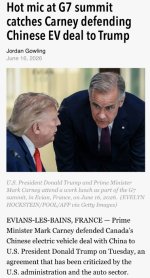
Carney arrived at the summit in France with no confirmed bilateral meeting with Trump. The G7 meeting marks the first time the prime minister and the president have been in the same room together this year.

Canada-U.S. Trade Minister Dominic LeBlanc and Chief Trade Negotiator Janice Charette met with U.S. Trade Representative Jamieson Greer on the sidelines of the summit to build on the work that was accomplished during their meeting with Greer in Washington on June 2. When asked whether Greer considers Canada’s EV deal with China a U.S. trade irritant, the minister said “he hasn’t described that to me in those, in those contexts” adding that the U.S. is very public about their trade irritants with Canada…be they real or fictitious.🙄

Ahead of the G7 summit, Carney downplayed bringing up any potential issues of trade with the U.S. president, adding that the leaders’ focus would be primarily on geopolitical events.
(YouTube & Spike , Chester and Sylvester)
 

Ron in Regina

"Voice of the West" Party
Apr 9, 2008
32,476
11,741
113
Regina, Saskatchewan
The Star exclusively reported Wednesday on the list of contentious trade irritants that are at the heart of U.S. concerns as the July 1 deadline looms for Canada, the U.S. and Mexico to declare their intentions about renewing the continental trade deal, known as CUSMA in Canada and USMCA in the United States.

If the three signatories don't declare an intention to renew the deal for another 16 years, a period of annual reviews would kick in, during which the pact would remain in force for another decade — unless any party gives the required six months’ notice to withdraw.
1781742510504.jpeg
Trump said that's clearly his preferred option at this time. "To me, I think it's better without it," he said. "I mean, to be honest with you, I'm not a big fan of it."

The United States-Mexico-Canada Agreement (USMCA) was primarily negotiated for the United States by then-U.S. Trade Representative Robert Lighthizer and senior White House advisor Jared Kushner, operating under the administration of President Donald Trump, so why would he like it?

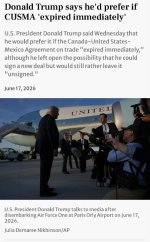
Trump's latest comments on the prospects of signing a new trade agreement go beyond his remarks last week, when he said he was "not looking to renew" the continental trade deal. On Wednesday, he also disputed the notion that the deal would nonetheless remain in force for another decade, saying, "I view it as possibly expiring immediately?” (???)
Asked by reporters to clarify what he meant by terminating the agreement, and if he meant allowing it to roll over into an annual process, Trump said, "I would rather not have the agreement, but I may sign it. But we do better as a country if we don't have an agreement.

Abandoning CUSMA (USMCA) would make America worse off economically, as a full termination of the continental trade agreement would disrupt $2.7 trillion in annual trade, destroy highly integrated cross-border supply chains, and invite retaliatory tariffs.

Without CUSMA’s protections, trading partners would be free to impose retaliatory tariffs on American exports. This would hurt U.S. farmers and manufacturers who rely on these major international markets.

CUSMA establishes predictable rules for intellectual property, digital trade, and labor. Eliminating these frameworks removes investment certainty for U.S. businesses, which can slow job growth, but that’s neither here nor there I guess.
While Trump did not specify on what measure the U.S. would "do better" without a North American free trade deal, there's plenty of evidence that CUSMA has helped fire up the U.S. economy.

Business Roundtable, an association of more than 200 chief executives of major U.S. companies, published a report that shows a 50 per cent increase in two-way trade in the region since the deal took effect, with 13 million U.S. jobs supported by trade with Canada and Mexico.

"Canada and Mexico purchase more U.S. manufactured goods than the next dozen U.S. trading partners combined and represent the top export markets for U.S. agricultural products," said Business Roundtable president Kristen Silverberg in an article for the Brookings Institution, a think-tank in Washington, D.C.
"The USMCA is the largest, fairest, most balanced, and modern trade agreement ever achieved. There’s never been anything like it," Trump told a signing ceremony in January 2020.

"This is a colossal victory for our farmers, ranchers, energy workers, factory workers and American workers in all 50 states," he said.

"The United States cannot withdraw from a congressionally approved trade agreement without the consent of Congress," concluded the Republican-led Senate Finance Committee in a 2020 report, and will Trump hold sway over Congress after November (?) or even leading up to November?
1781801791411.jpeg
 

Ron in Regina

"Voice of the West" Party
Apr 9, 2008
32,476
11,741
113
Regina, Saskatchewan
At the time of its signing of the North American trilateral trade agreement during his first term, Trump called it the best trade agreement ever. The regional trade accord has seen the economic fortunes of all three nations rise exponentially. Moreover, at a time when inflation continues to outpace wages and Canada has entered a technical recession, choking off the flow of goods and services is a sure-fire way to exacerbate stagnant economic growth.

Despite President Trump’s best efforts to pummel the Great White North’s economy through weaponized tariffs, much of Canada’s (and Mexico’s) goods are immune to the import duties unleashed on the rest of the world by the White House. Now, staring down a truculent political base, an anemic economy and a massive failure on Iran, the White House should be frantic to change the narrative.

An extension of CUSMA is just the type of win that will pacify the president’s base, including the business sector. Yet, it remains clear, the American president is equally intransigent and less sanguine about securing the economic future of the nation, much less the region.

As evidence, look no further than the still closed Gordie Howe Bridge. A newly minted multi-billion project connecting Ontario to Michigan, it’s meant to ease congestion and allow for easier transport and flow of billions in goods and services across the two nations. However, this seismic and badly needed engine of progress remains shut down as the Trump administration continues to put up barriers that not only harm a once-close ally but also extracts a heavy price on American businesses and jobs.
"Canada and Mexico purchase more U.S. manufactured goods than the next dozen U.S. trading partners combined and represent the top export markets for U.S. agricultural products," said Business Roundtable president Kristen Silverberg in an article for the Brookings Institution, a think-tank in Washington, D.C.
The Business Roundtable, an association of more than 200 chief executives of major U.S. companies, published a report that shows a 50 per cent increase in two-way trade in the region since the deal took effect, with 13 million U.S. jobs supported by trade with Canada and Mexico.

Not surprisingly, President Trump continues to double down on rhetoric suggesting the U.S. will walk away from the landmark agreement. Seemingly ignoring the economic malaise caused by his war of choice in Iran, Trump fails to account for his reckless military offensive in the Middle East which ultimately gave Tehran outsized leverage forcing his administration to accept a politically untenable deal.

Yet despite the braggadocio, the desperation was apparent, which is why it is highly likely Trump will eventually cave on his grandiosity and relinquish to an extension of CUSMA. But not before causing tremendous levels of angst and frustration.

At a press conference outlining his reasons behind the Iran deal, Trump said: “…rather than having your favorite president be Herbert Hoover, he was always the one I didn’t want to be…I didn’t want to see economic catastrophe. If you kept this going, that could have happened…”

If the war was a glidepath to “economic catastrophe,” walking away from CUSMA will lead to equally calamitous consequences. Perhaps that is why Canada’s prime minister offered a hand of support. Unfortunately, where Trump often remains consistent is in biting the hand that feeds him.
 

Ron in Regina

"Voice of the West" Party
Apr 9, 2008
32,476
11,741
113
Regina, Saskatchewan
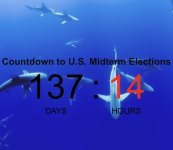
July 1 is the deadline for all three parties involved in the trade pact to decide whether to renew the deal for another 16 years, withdraw from the agreement altogether, or start an annual rolling review process that could last years…so…you’d ‘think’ there would be a trilateral meeting before Canada Day on July 1st, right?

In a statement to CTV News, the spokesperson said Leblanc is looking forward to meeting with his U.S. and Mexican counterparts on July 1 (on the day of the deadline), “as prescribed in the Canada-United States-Mexico Agreement.”(?)