


On the morning of 9th February 1855, the people of about five villages in Devon, in south west England, awoke to find that mysterious footprints had appeared in the snow.
The strange footprints stretched for about 100 miles, and passed through the villages of Topsham, Lympstone, Exmouth, Teignmouth, and Dawlish.
Incredibly, in one case they led right up to a 12 foot wall, ended abruptly, and continued on the other side! The snow at the top of the wall was not disturbed and a small gate on the wall was locked and secure.
In another instance the tracks led up to the Exe River (near Powdersham Castle) where they suddenly ended. On the other side the tracks continued as if the creature had swam (or walked) across the river. This would have been quite a feat given the fact that at this point in the river, it was considered a 'bay' and was actually over 2 miles wide!
In another instance the tracks ended at the entry of a drain pipe and reappeared at the other end as if the culprit had somehow passed through the pipe.
There were even reports that the tracks actually went up walls, sides of barns, and over houses.
Various explantions were put forward as to what could have caused the mysterious footprints, with some people blaming Springheeled Jack (a mysterious humanoid, first spotted in London in 1837 where he terrorised young women by wearing a glass "fish bowl" over his head and emitting blue flame from his mouth and had the uncanny ability to jump huge distances, but was subsequently spotted in other large cities in following decades such as Manchester, Liverpool, Birmingham and Sheffield, bounding from rooftop to rooftop) and others blaming the Devil himself. Needless to say, for the next few nights the villagers ensured that their doors and windows were locked.
Now, yet more mysterious footprints have appeared in the snow in Devon.
On 5th March, grandmother Jill Wade saw footprints in the snow in her garden in Woolsery.
And yes, they do appear to have been caused by Devil-like cloven hooves...
Ancient mystery returns as 'Satan's hoofprints' are spotted in Devon back garden
By Daily Mail Reporter
13th March 2009
Daily Mail
A 150-year-old mystery has reared its head after a woman woke to find 'Satan's hoofprints' dotted across freshly fallen snow in her back garden.
The single track of cloven-like prints - which appear to have been made by a TWO-legged creature - precisely resemble footprints recorded in the area in 1855.
The phenomenon, which has never been explained, became known as the 'Devil's foot prints' in a local legend.
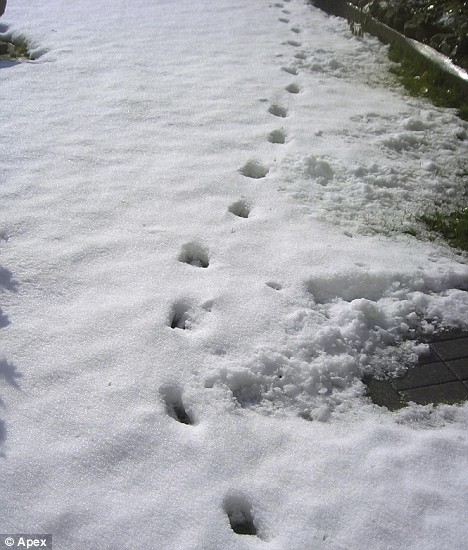 Unexplained: The imprints appear to have been made by a two-legged creature but scientists are not yet sure of the culprit
The new tracks appeared in fresh snow in Jill Wade's back garden on March 5th.
Grandmother Jill, 76, of Woolsery, Devon, said: 'I looked in the garden and it really intrigued me.
'I couldn't believe it - the footprints were in the shape of a cloven hoof. There were no other marks at all in the snow.
'I was quite surprised by it and I hadn't got a clue what it was, but I thought I would love to know.'
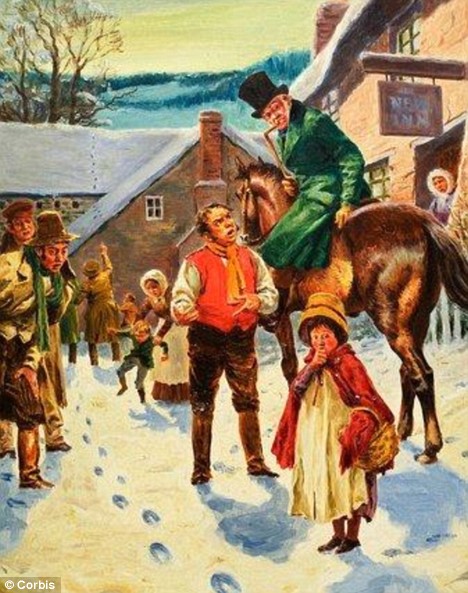
Legend: The original 'Devil's Footprints' appeared after light snowfall in 1855 and travelled from Exmouth to Topsham in Devon, even scaling rooftops
Scientists from the Centre for Fortean Zoology inspected the prints which measure 5ins (13cm) long with a stride of between 11 and 17ins (28 and 43cm).
Jonathan Downes, who runs the centre, is investigating whether the footprints could have been left by a hare or rabbits hopping on their hind legs.
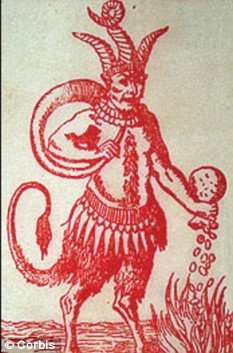
Villagers blamed the church for letting the devil into their communities
He said: 'Thousands of people across the world believe in the paranormal, but so far every single thing we have looked into has turned out to have a natural explanation. I'm sure these will as well.
'Do I believe that the Devil comes from the pits of Hell to wander around the gardens of North Devon? Of course not.
'But if you're asking if there are things that can't be explained by modern science, then yes. But human knowledge is expanding all the time.
'I believe that things that are currently put down to the paranormal will one day be explained by science.'
The original 'Devil's footprints' appeared after a light snowfall on February 8th, 1855, and travelled from Exmouth to Topsham in Devon - even crossing the estuary of the River Exe.
The tracks reportedly continued unbroken for 100 miles - appearing on both sides of 14-foot walls and locked gates.
Some villagers blamed the church, who had recently changed the standard prayer book, for letting the devil into their communities.
Others blamed animals, pranksters, and even a weather balloon - but the phenomenon, described as the 'great Devon mystery', was never explained.
dailymail.co.uk
**************************************
Devil's Footprints, Devon, England, 1855
Although documentation is sketchy, we do know that something extremely strange occurred in Topsham, England on 9th February 1855. Townspeople were shocked when they awoke to find unexplained footprints covering their yards, gardens, streets, and even roofs of their homes. Although other reports of unknown tracks are known to exist, this incident proved to be most unexplainable. The Times of London printed the following article on February 16, 1855.
The Tracks
The tracks covered a 100-mile course zigzagging from Topsham southward to the town of Totnes. Each of the prints were exactly 8 1/2 inches apart and measured 4 inches long by 2 3/4 inches wide. The prints were U-shaped. Some indicate that the tracks had a split in the middle indicating a cloven hoof. The prints were made in-line with each other further indicating that they were made by a 2-legged animal. Each of the prints were extremely clear, as if they had been 'branded' into the snow (could this have been caused by freezing rain on top of the new snow?).
Townspeople immediately set out to discover the culprit. Toting clubs, rakes, and other weapons, the people set off to find the monster that created the footprints.
The tracks appeared to follow no certain course. In one case they led right up to a 12 foot wall, ended abruptly, and continued on the other side! The snow at the top of the wall was not disturbed and a small gate on the wall was locked and secure.
In another instance the tracks led up to the Exe River (near the Powdersham Castle) where they suddenly ended. On the other side the tracks continued as if the creature had swam (or walked) across the river. This would have been quite a feat given the fact that at this point in the river, it was considered a 'bay' and was actually over 2 miles wide. Of course details are sketchy on the entire incident so could it have been possible that the river was frozen at this time?
In another instance the tracks ended at the entry of a drain pipe and reappeared at the other end as if the animal had somehow passed through the pipe.
There were even reports that the tracks actually went up walls, sides of barns, and over houses. Townspeople were baffled as they followed the tracks that crisscrossed through cemeteries, in popular town squares, in people's yards, over snow covered wagons, and in same cases led right up to people's doors were they stopped and continued on in another direction (including back-tracking on top of themselves).
Theories Abound
One local clergyman thought he knew the answer. He claimed that the tracks were the footprints of the devil. He believed this event occurred due to the waning morals of the local people and that the occurrence served as a warning to all to change their ways.
Of course, others produced more believable theories. Sir Richard Owens suggested that the prints were those of a badger (even though he never actually saw the prints and created his theory on the description he heard from others). Other theories included rabbits, birds, otters, and rats.
One of the most believable theories came from Geoffrey Household who edited a book that contained all of the newspaper correspondence collected concerning the incident.
Devil's Footprints
The strange footprints stretched for about 100 miles, and passed through the villages of Topsham, Lympstone, Exmouth, Teignmouth, and Dawlish.
Incredibly, in one case they led right up to a 12 foot wall, ended abruptly, and continued on the other side! The snow at the top of the wall was not disturbed and a small gate on the wall was locked and secure.
In another instance the tracks led up to the Exe River (near Powdersham Castle) where they suddenly ended. On the other side the tracks continued as if the creature had swam (or walked) across the river. This would have been quite a feat given the fact that at this point in the river, it was considered a 'bay' and was actually over 2 miles wide!
In another instance the tracks ended at the entry of a drain pipe and reappeared at the other end as if the culprit had somehow passed through the pipe.
There were even reports that the tracks actually went up walls, sides of barns, and over houses.
Various explantions were put forward as to what could have caused the mysterious footprints, with some people blaming Springheeled Jack (a mysterious humanoid, first spotted in London in 1837 where he terrorised young women by wearing a glass "fish bowl" over his head and emitting blue flame from his mouth and had the uncanny ability to jump huge distances, but was subsequently spotted in other large cities in following decades such as Manchester, Liverpool, Birmingham and Sheffield, bounding from rooftop to rooftop) and others blaming the Devil himself. Needless to say, for the next few nights the villagers ensured that their doors and windows were locked.
Now, yet more mysterious footprints have appeared in the snow in Devon.
On 5th March, grandmother Jill Wade saw footprints in the snow in her garden in Woolsery.
And yes, they do appear to have been caused by Devil-like cloven hooves...
Ancient mystery returns as 'Satan's hoofprints' are spotted in Devon back garden
By Daily Mail Reporter
13th March 2009
Daily Mail
A 150-year-old mystery has reared its head after a woman woke to find 'Satan's hoofprints' dotted across freshly fallen snow in her back garden.
The single track of cloven-like prints - which appear to have been made by a TWO-legged creature - precisely resemble footprints recorded in the area in 1855.
The phenomenon, which has never been explained, became known as the 'Devil's foot prints' in a local legend.
The new tracks appeared in fresh snow in Jill Wade's back garden on March 5th.
Grandmother Jill, 76, of Woolsery, Devon, said: 'I looked in the garden and it really intrigued me.
'I couldn't believe it - the footprints were in the shape of a cloven hoof. There were no other marks at all in the snow.
'I was quite surprised by it and I hadn't got a clue what it was, but I thought I would love to know.'
Legend: The original 'Devil's Footprints' appeared after light snowfall in 1855 and travelled from Exmouth to Topsham in Devon, even scaling rooftops
Scientists from the Centre for Fortean Zoology inspected the prints which measure 5ins (13cm) long with a stride of between 11 and 17ins (28 and 43cm).
Jonathan Downes, who runs the centre, is investigating whether the footprints could have been left by a hare or rabbits hopping on their hind legs.
Villagers blamed the church for letting the devil into their communities
He said: 'Thousands of people across the world believe in the paranormal, but so far every single thing we have looked into has turned out to have a natural explanation. I'm sure these will as well.
'Do I believe that the Devil comes from the pits of Hell to wander around the gardens of North Devon? Of course not.
'But if you're asking if there are things that can't be explained by modern science, then yes. But human knowledge is expanding all the time.
'I believe that things that are currently put down to the paranormal will one day be explained by science.'
The original 'Devil's footprints' appeared after a light snowfall on February 8th, 1855, and travelled from Exmouth to Topsham in Devon - even crossing the estuary of the River Exe.
The tracks reportedly continued unbroken for 100 miles - appearing on both sides of 14-foot walls and locked gates.
Some villagers blamed the church, who had recently changed the standard prayer book, for letting the devil into their communities.
Others blamed animals, pranksters, and even a weather balloon - but the phenomenon, described as the 'great Devon mystery', was never explained.
dailymail.co.uk
**************************************
Devil's Footprints, Devon, England, 1855
Although documentation is sketchy, we do know that something extremely strange occurred in Topsham, England on 9th February 1855. Townspeople were shocked when they awoke to find unexplained footprints covering their yards, gardens, streets, and even roofs of their homes. Although other reports of unknown tracks are known to exist, this incident proved to be most unexplainable. The Times of London printed the following article on February 16, 1855.
Considerable sensation has been evoked in he towns of Topsham, Lympstone, Exmouth, Teignmouth, and Dawlish, in the south of Devon, in consequence of the discovery of a vast number of foot tracks of a most strange and mysterious description. The superstitious go so far as to believe that they are the marks of Satan himself; and that great excitement has been produced among all classes may be judged from the fact that the subject has been descanted on from the pulpit.
It appears that on Thursday night last there was a very heavy fall of snow in the neighborhoods of Exeter and the south of Devon. On the following morning, the inhabitants of the above towns were surprised at discovering the tracks of some strange and mysterious animal, endowed with the power of ubiquity, as the foot prints were to be seen in all kinds of inaccessible places - on the tops of houses and narrow walls, in gardens and courtyards enclosed by high walls and palings, as well as in open fields. There was hardly a garden in Lympstone where the footprints were not observed.
The track appeared more like that of a biped than a quadruped, and the steps were generally eight inches in advance of each other. The impressions of the feet closely resembled that of a donkey's shoe, and measured from an inch and a half to (in some instances) tow and a half inches across. Here and there it appeared as if cloven, but in the generality of the steps the shoe was continuous, and, from the snow in the center remaining entire, merely showing the outer crest of the foot, it must have been convex [concave?].
The creature seems to have approached the doors of several houses and then to have retreated, but no one has been able to discover the standing or resting point of this mysterious visitor. On Sunday lat the Rev. Mr. Musgrave alluded to the subject in his sermon, and suggested that possibility of the footprints being those of a kangaroo,; but this could scarcely have been the case, as they were found on both sides of the estuary of the Exe.
At present it remains a mystery, and many superstitious people in the above towns are actually afraid to go outside their doors after night.
This strange incident occurred in Topsham, Lympstone, Exmouth, Teignmouth, and Dawlish. Most of the details came from readers to the editors of the Illustrated London News. Strangely, most of the newspapers failed to report on the incident until almost a week later.It appears that on Thursday night last there was a very heavy fall of snow in the neighborhoods of Exeter and the south of Devon. On the following morning, the inhabitants of the above towns were surprised at discovering the tracks of some strange and mysterious animal, endowed with the power of ubiquity, as the foot prints were to be seen in all kinds of inaccessible places - on the tops of houses and narrow walls, in gardens and courtyards enclosed by high walls and palings, as well as in open fields. There was hardly a garden in Lympstone where the footprints were not observed.
The track appeared more like that of a biped than a quadruped, and the steps were generally eight inches in advance of each other. The impressions of the feet closely resembled that of a donkey's shoe, and measured from an inch and a half to (in some instances) tow and a half inches across. Here and there it appeared as if cloven, but in the generality of the steps the shoe was continuous, and, from the snow in the center remaining entire, merely showing the outer crest of the foot, it must have been convex [concave?].
The creature seems to have approached the doors of several houses and then to have retreated, but no one has been able to discover the standing or resting point of this mysterious visitor. On Sunday lat the Rev. Mr. Musgrave alluded to the subject in his sermon, and suggested that possibility of the footprints being those of a kangaroo,; but this could scarcely have been the case, as they were found on both sides of the estuary of the Exe.
At present it remains a mystery, and many superstitious people in the above towns are actually afraid to go outside their doors after night.
The Tracks
The tracks covered a 100-mile course zigzagging from Topsham southward to the town of Totnes. Each of the prints were exactly 8 1/2 inches apart and measured 4 inches long by 2 3/4 inches wide. The prints were U-shaped. Some indicate that the tracks had a split in the middle indicating a cloven hoof. The prints were made in-line with each other further indicating that they were made by a 2-legged animal. Each of the prints were extremely clear, as if they had been 'branded' into the snow (could this have been caused by freezing rain on top of the new snow?).
Townspeople immediately set out to discover the culprit. Toting clubs, rakes, and other weapons, the people set off to find the monster that created the footprints.
The tracks appeared to follow no certain course. In one case they led right up to a 12 foot wall, ended abruptly, and continued on the other side! The snow at the top of the wall was not disturbed and a small gate on the wall was locked and secure.
In another instance the tracks led up to the Exe River (near the Powdersham Castle) where they suddenly ended. On the other side the tracks continued as if the creature had swam (or walked) across the river. This would have been quite a feat given the fact that at this point in the river, it was considered a 'bay' and was actually over 2 miles wide. Of course details are sketchy on the entire incident so could it have been possible that the river was frozen at this time?
In another instance the tracks ended at the entry of a drain pipe and reappeared at the other end as if the animal had somehow passed through the pipe.
There were even reports that the tracks actually went up walls, sides of barns, and over houses. Townspeople were baffled as they followed the tracks that crisscrossed through cemeteries, in popular town squares, in people's yards, over snow covered wagons, and in same cases led right up to people's doors were they stopped and continued on in another direction (including back-tracking on top of themselves).
Theories Abound
One local clergyman thought he knew the answer. He claimed that the tracks were the footprints of the devil. He believed this event occurred due to the waning morals of the local people and that the occurrence served as a warning to all to change their ways.
Of course, others produced more believable theories. Sir Richard Owens suggested that the prints were those of a badger (even though he never actually saw the prints and created his theory on the description he heard from others). Other theories included rabbits, birds, otters, and rats.
One of the most believable theories came from Geoffrey Household who edited a book that contained all of the newspaper correspondence collected concerning the incident.
I think that Devenport Dockyard released, by accident, some sort of experimental balloon, and trailed 2 shackles on the end of ropes. The impressions left in the snow by these shackles went up the sides of houses, over haystacks, etc. A major Carter, a local man, tells me that his grandfather worked at Devenport at the time, and that the whole thing was hushed up because the balloon destroyed a number of conservatories, greenhouses, windows, etc. He says the balloon finally came down in Honiton.
But even this theory is difficult to prove. If a wondering balloon were responsible for the tracks, how do we explain the fact that the tracks covered much of the territory scrambling all over the place. A balloon would indeed tend to follow a much straighter path. Besides, the tracks followed a North to South path and not surprisingly, the prevailing winds at that time were from East to West...
Devil's Footprints
Last edited:
